
Why Great Security Leaders Think Like Business Leaders
Technical Expertise May Get You Hired. Business Thinking Helps You Lead.
Brian Gerard
6/29/20264 min read
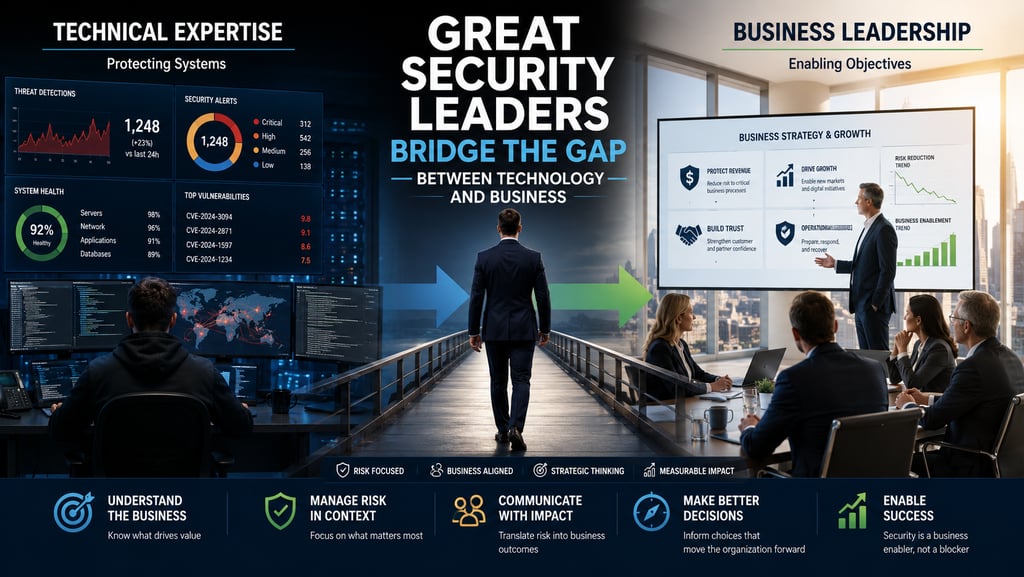
Bear with me on this. Let's say we ask the average security engineer what success looks like, and they may say something like: Zero critical vulnerabilities, near-perfect patch compliance, or even perfect audit results. I would say that those are worthy goals.I mean, who wouldn’t want to pass an audit and be as patched as possible?!
But if we were to ask a CEO the same question, this is where you will likely hear something different. A CEO will talk about KPIs that directly impact the business. They talk about business growth and customer trust. They will expand on the organization’s operational resilience, and how they can best protect revenue. They undoubtedly will speak to the best way to manage enterprise risk
Neither perspective is wrong.
But one is broader.
The most effective security leaders understand that cybersecurity exists to support the business, not the other way around.
That's why the best security leaders don't just think like security professionals.
They think like business leaders.
A Good Security Leader Must Refocus
Early in mine, and I’m sure in your cybersecurity careers, I measured success by technical capability.
I learned how to investigate incidents and deploy controls. I learned how to manage vulnerabilities and secure infrastructure.
Those skills remain essential.
But leadership requires an additional skill set.
It requires understanding:
Why does this matter to the business?
That simple question changes how priorities are set, investments are justified, and risks are communicated.
Security Is a Business Function
One lesson I've learned over the years is that cybersecurity is no longer simply an IT responsibility.
Every significant security decision has business implications.
Whether it's implementing multi-factor authentication, selecting a cloud provider, or onboarding a third-party vendor.
Each decision involves balancing the following points:
Risk
Cost
Operational efficiency
Customer experience
Organizational objectives
This is what I've come to learn as business leadership.
The Best Security Leaders Speak Two Languages
Great security leaders are fluent in both:
Technology
and
Business
They can explain a vulnerability to an engineer, then explain its business implications to the CFO. The technical details may change, however, the message should not.
They Prioritize Business Risk Not Just Technical Severity
A critical vulnerability doesn't automatically represent the highest business risk.
Likewise, a medium-severity technical finding may expose a critical business process.
Great security leaders ask questions such as:
What business capability is affected?
What happens if this control fails?
What is the financial impact?
How would our customers be affected?
They recognize that risk cannot be measured by technology alone.
They Invest Where It Matters Most
We all know that security budgets are never unlimited. Every investment is a choice. Should funding go toward such things as another security platform? Identity modernization? Security awareness? How about third-party risk management?
Great security leaders evaluate these decisions through a business lens.
They ask: "Which investment most effectively reduces organizational risk?"
Not: "Which technology is newest?"
They Build Relationships Before They Need Them
One of the biggest differences between managers and leaders is influence.
Strong security leaders don't appear only when there's a breach.
They build trust with the various departments in the business to gain understanding. They will build that working relationship with the Finance team and the Legal team. Human Resources is a big relationship that should be fostered and so is Operations. Ultimately, building a good relationship with the Executive Leadership is the goal. You want the decision makers to trust your judgement and value your input. All of this has to be done in good faith so these teams become partners in achieving business objectives.
Not simply owners of security controls.
They Understand That Security Enables Growth
Cybersecurity is often viewed as something that slows business down.
But mature security programs do the opposite.
They enable organizations to enter new markets and satisfy customer requirements. A mature security program will advance regulatory obligations, and be there to support mergers and acquisitions early in the process. Mature security programs enable the business to adopt new technologies confidently.
Security isn't merely about preventing bad outcomes.
It's about enabling good ones.
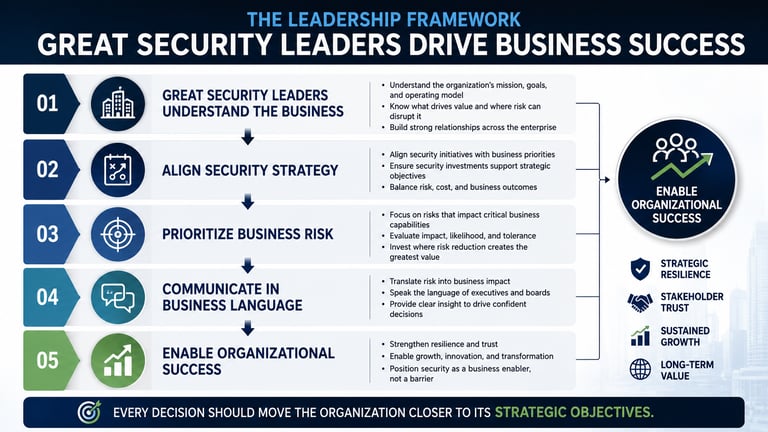
Every decision should move the organization closer to its strategic objectives.
The Questions Great Leaders Ask
I've found that strong security leaders consistently ask different questions than everyone else.
Instead of asking: "How many vulnerabilities do we have?"
They ask: "Which vulnerabilities could significantly disrupt the business?"
Instead of asking: "Did we pass the audit?"
They ask: "Did we meaningfully reduce risk?"
Instead of asking: "What technology should we buy?"
They ask: "What business problem are we trying to solve?"
Those are leadership questions.
Leadership Is Measured by Influence
Leadership isn't measured by the number of security tools deployed. It is not measured by the size of the security team, nor is it measured by the complexity of the environment. It's measured by influence.
Can you help executives make better decisions?
Can you align security with business priorities?
Can you build trust across the organization?
That's what separates technical expertise from executive leadership.
So let's sum this all up....
Technology will continue to evolve.
Threats will continue to change.
The organizations that succeed will not necessarily be those with the most advanced tools.
They will be the ones led by security professionals who understand the business they're protecting.
Because cybersecurity has never been about protecting servers.
It's about protecting an organization's ability to achieve its mission.
That's why the most effective security leaders don't simply think like technologists.
They think like business leaders.
Contact
Reach out for tailored security solutions.
© 2026. All rights reserved.