
Why Every Security Program Needs a North Star
Without a Clear Direction, Even Good Security Efforts Can Fail
Brian Gerard
6/8/20263 min read
Indulge me in this thought experiment, please. Imagine you are setting out on a cross-country journey without a destination. You might drive for hours. You might even make progress. But eventually, someone is going to ask: "Where exactly are we trying to go?"
Surprisingly, many cybersecurity programs operate this way. We see projects get launched. Tools get purchased. Controls get implemented. And metrics get reported.
However, when asked what success looks like, the answer is often unclear.
Our resultant program remains one that is busy, but not necessarily effective.
This is why every security program needs a North Star.
Activity Is Not Strategy
One of the most common challenges I have observed throughout my career is that organizations often confuse activity with progress. Security teams are constantly engaged with important activities like vulnerability remediation and audit preparation. They work on implementation on new tools and further tune those tools to get good metrics and drown out the alert fatigue. Security teams will build and document their incident response playbooks. Please don’t misinterpret this, these activities DO have value, but if they are not connected to a larger, strategic objective, they can become disconnected efforts competing for limited resources.
A mature security program is not defined by how much work it performs.
It is defined by whether that work moves the organization toward a clearly defined outcome.
What Is a Security North Star?
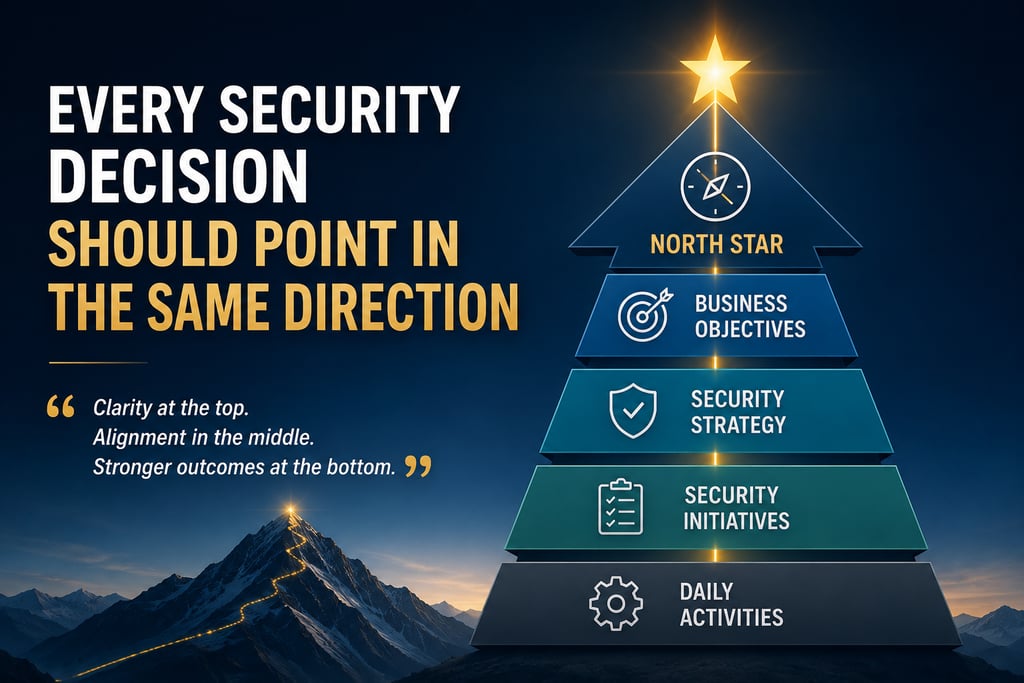
A North Star is the guiding objective that informs security decisions across the organization. It provides clarity when priorities compete; It provides context when resources are limited. Most importantly, A North Star creates alignment between security activities and business objectives.
A security North Star should answer a simple question: "What are we ultimately trying to achieve?"
Many examples can and may include answers like "Protecting customer trust", or "Supporting business growth securely." They can be about "reducing operational risk" or "Improving organizational resilience." The specific answer will vary by organization.
The important part is having one.
So What Happens Without a North Star?
When security lacks a guiding strategy, several problems emerge.
Priorities Constantly Shift - The loudest issue becomes the most important issue.
Resources Become Fragmented - Teams chase multiple initiatives without clear alignment
Security Investments Lose Focus - New technologies are purchased without understanding how they support long-term goals.
Success Becomes Difficult to Measure - Teams struggle to answer a simple question: "Are we becoming more secure?"
The Difference Between Goals and a North Star
Organizations often confuse tactical goals with strategic direction.
Let's look at some examples:
Goal - Implement multi-factor authentication.
Goal - Reduce critical vulnerabilities.
Goal - Complete an audit.
These are important initiatives, but they are not the destination. A North Star sits above them.
For example:
Increase organizational resilience against cyber threats.
Now every initiative can be evaluated against that objective. Does it improve resilience? If yes, it deserves attention. If not, it may require reconsideration.
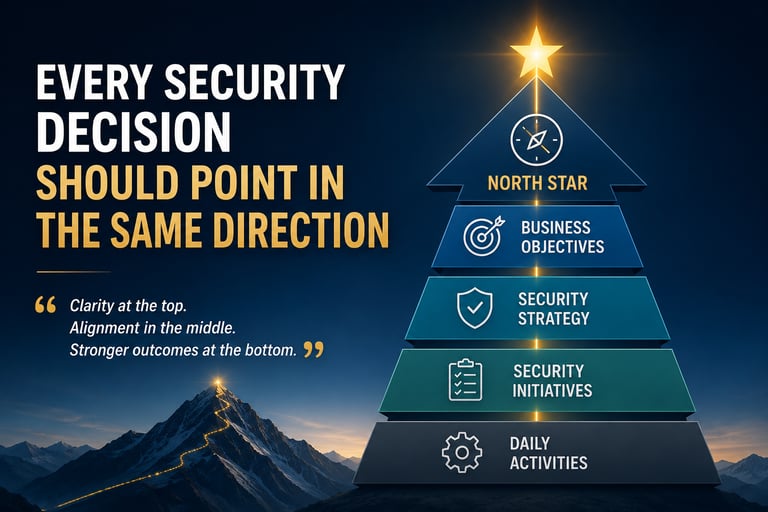
The strongest programs create a direct connection between daily activities and organizational goals.
Why This Matters to Executives
Executives rarely ask: "How many vulnerabilities were patched?"
They want to know how the business is being safeguarded from the bad actors of the world. They will ask questions like: "Are we reducing risk?" Or, "Are we protecting critical operations?". Executives want to know about how are we supporting growth, and are we improving resilience?
These questions are fundamentally strategic. A North Star helps security leaders answer them clearly.
How do Strong Security Leaders Work Differently
Effective security leaders spend as much time defining direction as they do implementing controls. They consistently connect security decisions to business objectives and organizational priorities. Due to fiduciary requirements, they may have to develop risk tolerance plans and long-term outcomes. Security is not simply about protecting technology, it is about enabling the organization to achieve its objectives securely.
When a North Star Exists
Organizations with a clearly defined security vision are more likely to make better investment decisions. When they can align priorities more effectively, they can communicate more clearly with leadership. This will reduce competing initiatives and allow teams to focus on outcomes instead of activities.
Most importantly, organizations will understand why they are doing what they are doing.
The most successful security programs are not necessarily the ones with the most tools, the largest budgets, or the most initiatives.
They are the ones with a clear sense of direction.
When priorities compete, resources become constrained, and risks evolve, a North Star provides what every security leader needs most: Clarity!
Without a destination, even good security efforts can drift.
With one, every decision becomes easier to make.
Contact
Reach out for tailored security solutions.
© 2026. All rights reserved.