
What Boards Actually Want From Cybersecurity Leaders
Many security professionals assume boards want more technical detail. In reality, most boards want less technical detail and more clarity around risk, resilience, and business impact.
Brian Gerard
6/21/20263 min read
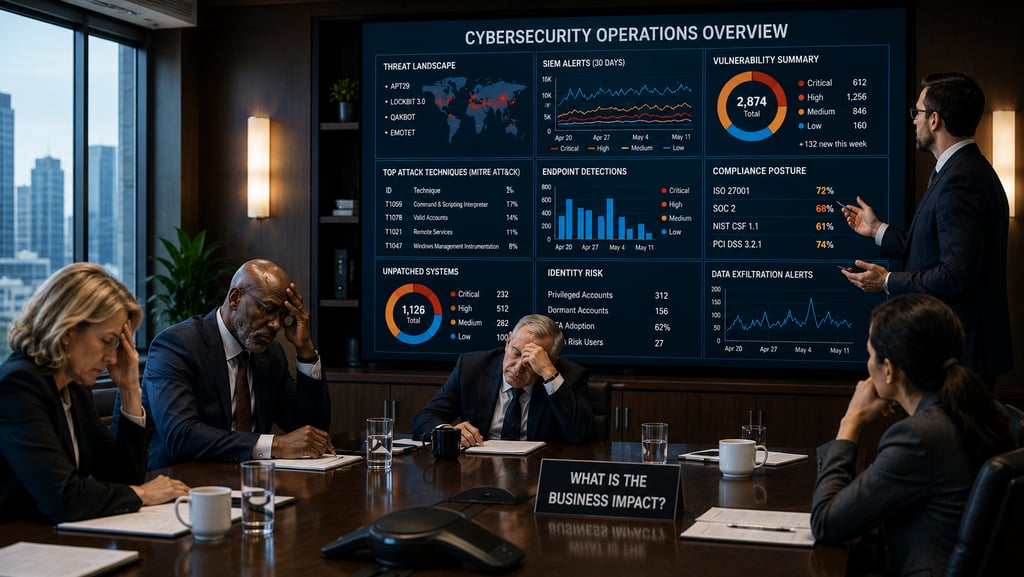

Imagine you have ten minutes to brief your Board of Directors on cybersecurity.
What would you discuss? Would you bring up critical vulnerabilities? How about SIEM alerts? Phishing statistics?Patching metrics?
I mean, you could report on all of the above, but chances are, that's not what the board wants to hear.
Boards are not responsible for managing firewalls, reviewing vulnerability scans, or monitoring security alerts.
They are responsible for governing organizational risk.
And that's exactly what they expect cybersecurity leaders to help them understand.
A very bored Board
The Communication Gap
One of the biggest challenges in cybersecurity is not technology. It's translation. Security teams naturally think in terms of threats and vulnerabilities. We think about controls and technical findings.
Boards, on the other hand, think in terms of business risk and operational resilience. They need to be appraised on regulatory exposure, financial impact, and of course, their reputation.
When cybersecurity leaders fail to bridge that gap, reporting becomes less effective. Information is shared; understanding is not.
What Boards Actually Care About
In my experience, board members typically care about four fundamental questions:
Are We Exposed?
What are the organization's most significant cybersecurity risks, not every risk.
What are the risks that could materially impact the business.
Are We Prepared?
Can the organization detect, respond to, and recover from a cyber incident?
Preparation often matters more than prevention.
Are We Improving?
Is our cybersecurity posture improving over time?
Boards want trends. Not snapshots.
What Decisions Need To Be Made
Where do leaders need support, investment, or strategic direction?
The best board discussions focus on decisions, not status updates.
The Problem With Traditional Security Reporting
Many cybersecurity reports will contain vulnerability counts, blocked attacks, patching percentages, and security alerts.
These metrics may be operationally useful, but they rarely answer the questions boards are asking.
Consider this example:
"We identified 2,000 critical vulnerabilities this quarter."
A board member's likely response will be:
"So what?"
The metric you just reported lacks business context.
Now add the business context and consider the following:
"We identified vulnerabilities affecting systems that support customer transactions. Remediation efforts reduced potential business exposure by 40%."
That tells a different story. A story that now full engages or at the very least, gets the attention of your board members.
From Technical Metrics to Business Outcomes
The most effective cybersecurity leaders translate technical findings into business impact.
Instead of reporting:
"Phishing attempts increased."
Report:
"We observed increased phishing activity targeting finance personnel. Existing controls prevented compromise, but continued activity presents fraud risk."
Instead of reporting:
"We have identity management gaps."
Report:
"Identity-related weaknesses increase the likelihood of unauthorized access to critical business systems."
The issue hasn't changed.
The language has.
What Great Board Reporting Looks Like
Strong board communication is:
Concise - Complexity creates confusion.
Business-Focused - Connect cybersecurity to organizational objectives.
Risk-Oriented - Focus on exposure, likelihood, and impact.
Actionable - Highlight decisions and strategic implications.
The goal is not to demonstrate technical expertise. The goal is to support governance and decision-making.
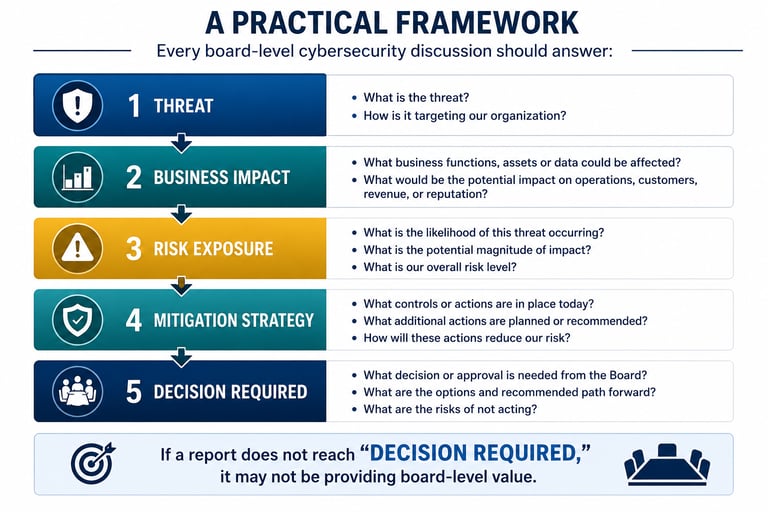
What Strong Cybersecurity Leaders Do Differently
Strong cybersecurity leaders understand that boards are not looking for operational details.
They are looking for confidence.
Confidence that risks are understood. That priorities are aligned. That investments are effective. Cybersecurity leaders want to see that resilience is improving and their leadership is prepared. This requires communication skills that extend well beyond technology.
The Shift From Reporting to Advising
The most effective cybersecurity leaders don't simply report information.
They provide insight. They are the ones that help their leadership understand where risk exists and why those risks matter. They give their leadership the options that are available and what trade-offs should be considered. At that point, cybersecurity becomes a strategic advisor to the business.
When cybersecurity communication aligns with board expectations the executives become more engaged. Funding discussions may improve while priorities become more clear. Risk decisions become more informed.
Most importantly, cybersecurity becomes integrated into broader business strategy.
Boards do not expect cybersecurity leaders to eliminate risk. They expect them to understand it, communicate it clearly, and help the organization make informed decisions.
The most valuable cybersecurity leaders are not necessarily the most technical. They are the ones who can translate complex risk into meaningful business conversations. Because ultimately, boards are not managing cybersecurity. They are governing business risk.
Contact
Reach out for tailored security solutions.
© 2026. All rights reserved.