
The Most Expensive Cybersecurity Mistake: Misaligned Priorities
Why Organizations Often Fix the Wrong Risks
Brian Gerard
6/1/20263 min read


Let's imagine a scenario where two security issues land on your desk at the same time. The first is a critical vulnerability affecting a non-production system. The second, a third-party vendor with privileged access to customer data who has not completed a security assessment in over two years.
Which risk get's addressed first?
In many organizations, the answer is the vulnerability. Why, you may ask? Because it feels urgent.
However, urgency and risk are not the same thing. When organizations confuse the two, they may become the most expensive cybersecurity mistake that they can make.
The Illusion of Urgency
Cybersecurity teams are constantly bombarded with critical vulnerabilities. They get inundated with security alerts, audit findings, and copious threat intelligence feeds. There are always compliance deadlines that need to be met.
Every issue appears important. Every issue demands attention.
The result is predictable. Organizations begin prioritizing based on what is most visible, loudest, or newest. But that is not necessarily what poses the greatest risk.
When Everything Is Critical, Nothing Is
How many of us in the industry have come to experience the "if everything is critical, than nothing is" conundrum?
One pattern I've observed throughout my career, is that organizations can become trapped in a cycle of reactive security. Every vulnerability is treated as a crisis. Every finding receives equal attention. Every new threat dominates the conversation. When this happens, teams will eventually become overwhelmed. Their resources become diluted, and genuinely significant risks compete for attention with lower-impact issues.
The Difference Between Risk and Urgency
These concepts are often treated as interchangeable, but they are not.
The "Urgency" asks: "How quickly do we need to act?"
While the "Risk" asks: "What happens if we don't?"
Those are very different questions. A CVE may have a high CVSS, AND may have limited business impact . Meanwhile, a moderate technical issue affecting a critical revenue-generating process could represent a far greater organizational risk.
Technical Severity vs Business Impact
As security professionals, we often focus on technical measurements like the aforementioned high CVSSs of the world, and the vulnerability counts. We'll look at exploitability ratings and threat indicators, and really, don't get me wrong, these are valuable metrics for assessment, but executives care about other things. They're looking out for operational disruption and customer impact. They have fiduciary responsibilities to limit financial exposure and comply with regulatory consequences. And yes, they are very concerned with any reputational damage that may be incurred.
This is where security programs frequently lose alignment.
Why Organizations Fix the Wrong Risks
The way I see it, and please leave a comment if you see it differently, there are several factors that may contribute to this problem:
Visibility Bias - Highly visible issues receive more attention.
Compliance Pressure - Audit findings often drive priorities regardless of actual risk.
Technical Comfort Zones - Security teams naturally focus on technical problems because they are easier to measure.
Organizational Silos - Security teams may lack sufficient visibility into business processes and objectives.
A simple model looks like this:
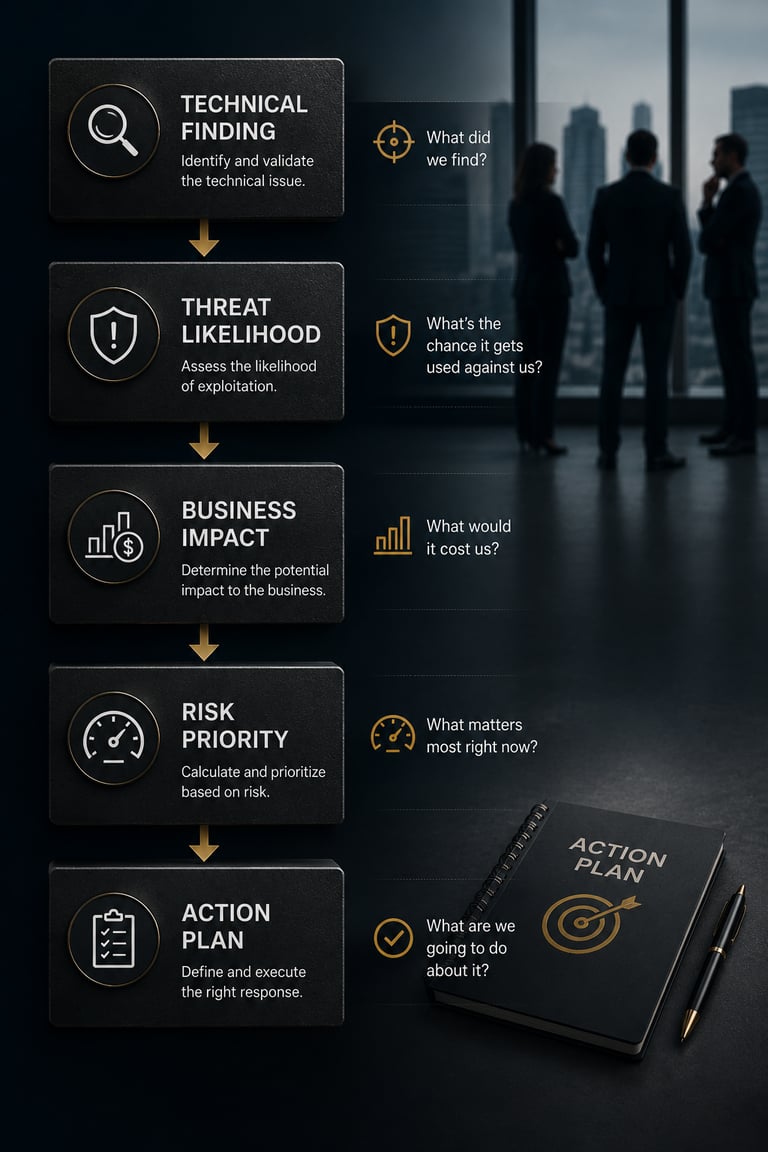
Thanks ChatGPT for another great visual!
What our walkaway should be is that technical severity is only one input. We should understand that is should not determine priority by itself.
When Priorities Are Aligned
I believe that when organizations consistently align security priorities with business risk, they tend to make better investment decisions. They can reduce meaningful exposure faster. They • improve executive engagement. They avoid reactive security cycles.
Most importantly, they spend their limited resources where they create the greatest reduction in risk.
The most expensive cybersecurity mistakes are rarely technical. More often, they are prioritization failures. Organizations do not fail because they miss every risk. They fail because they spend too much time addressing the wrong ones. The goal of cybersecurity is not to fix everything. The goal is to understand what matters most — and act accordingly for the business.
Throughout my career, I've found that some of the most valuable security conversations are not about technology at all. They're about understanding business objectives, evaluating risk realistically, and ensuring that limited resources are focused where they can make the greatest impact.
Contact
Reach out for tailored security solutions.
© 2026. All rights reserved.