
The Hidden Cost of Security Complexity
When More Security Doesn't Always Mean Less Risk
Brian Gerard
7/6/20263 min read
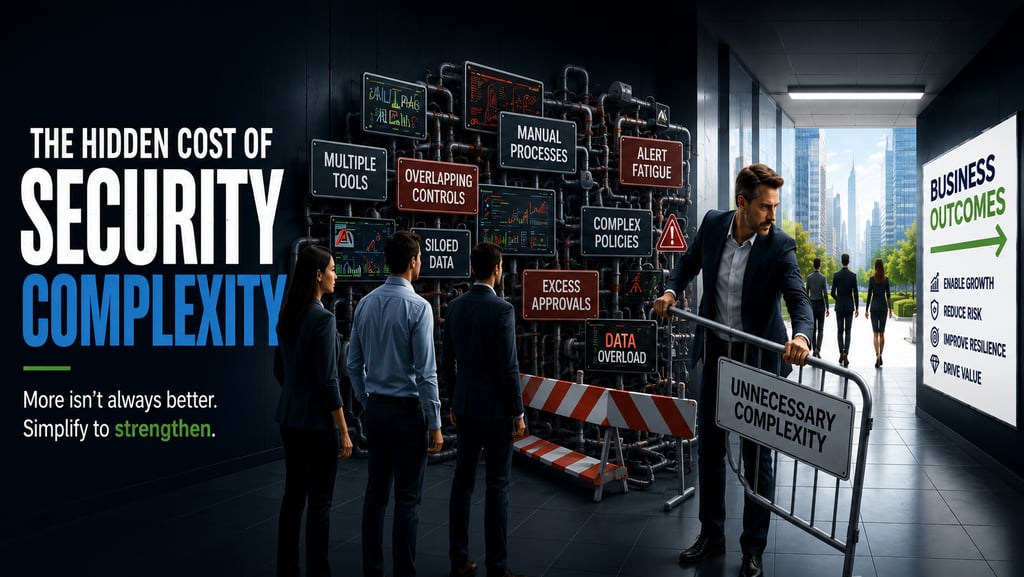

For years, the cybersecurity industry has responded to new threats with a familiar solution:
They buy tools, deploy controls, add another dashboard. The GR&C team will write more policies.
Individually, each decision often makes sense. However, collectively, they can create something far more dangerous:
Complexity.
Ironically, some of the greatest risks organizations face today are not created by attackers.
They're created by security programs that have become too complicated to manage effectively.
Complexity Is the Silent Threat
We all want our organizations to have stronger security. Over time, that complexity often leads to additional security platforms and overlapping technologies. We begin to suffer from alert fatigue and more approval workflows. Documentation builds and the manual processes mount.
Each layer is added with good intentions.
But eventually, security teams find themselves managing an ecosystem so complex that it becomes difficult to understand, maintain, and improve.
More Controls Don't Always Mean More Security
One of the biggest misconceptions in cybersecurity is that adding controls automatically reduces risk.
Sometimes it does.
Sometimes it simply adds friction.
Consider an environment with multiple vulnerability scanners or three identity management platforms. Other environments may have multiple endpoint detection and response tools. Even still, some organizations may have overlapping monitoring solutions with redundant reporting dashboards
Has security improved?
Or has complexity increased?
The answer isn't always obvious.
Complexity Creates Blind Spots
As environments become more complicated, unintended consequences begin to emerge.
Important alerts become buried in noise (alert fatigue is real).
Teams struggle to determine which dashboard contains THE source of truth.
Manual processes slow response times.
Ownership becomes unclear.
Instead of increasing visibility, complexity often fragments it.
The Human Cost
Security complexity affects people just as much as technology.
Analysts spend more time navigating tools than investigating threats.
Engineers become overwhelmed by competing priorities.
Business units encounter increasingly complicated security processes.
Eventually, everyone begins working around security instead of with it.
When security becomes difficult to understand, people naturally look for shortcuts.
That's when risk increases.
Complexity Slows the Business
Every new security requirement introduces some level of operational cost.
Approvals take longer.
Projects move more slowly.
Onboarding vendors becomes more difficult.
Innovation encounters additional barriers.
Security should protect the business.
It should not unintentionally become a barrier to progress.
A Practical Example
Imagine two organizations with similar security budgets.
Organization A
42 security tools
Multiple overlapping capabilities
Separate reporting systems
Manual integrations
Alert fatigue across the SOC
Organization B
18 carefully integrated tools
Clearly defined ownership
Automated workflows
Unified reporting
Business-aligned governance
Which organization is likely to respond faster to an incident?
Which one is easier to manage?
Which one can explain its security posture more clearly to executives?
Sometimes, simplicity becomes a competitive advantage.
Complexity Is Also a Business Risk
When security programs become overly complex, they introduce risks beyond technology.
Complexity can lead to things like increased operating costs, slower decision-making, or delayed incident response times.
This complexity breeds inconsistent governance, reduces organizational agility, and definitely contributes heavily to employee frustration.
These are business risks—not just technical ones.
What Great Security Leaders Do Differently
Strong security leaders don't ask:
"What else can we add?"
They ask:
"What can we simplify?"
They recognize that every new control introduces maintenance, training, integration, governance, and operational overhead.
Before introducing something new, they evaluate whether it creates more value than complexity.
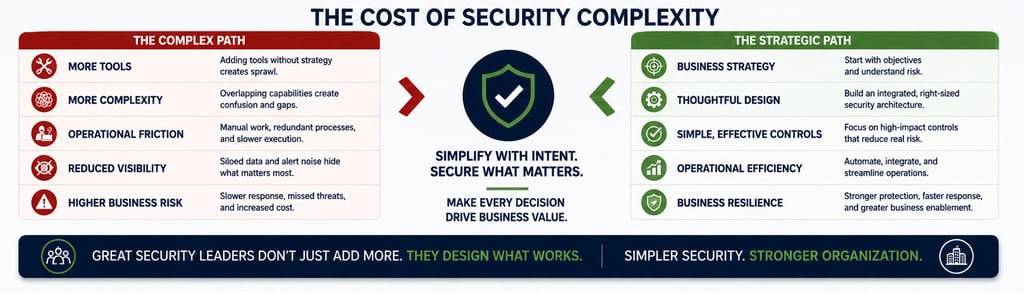
The goal is not to build the most complex security program. The goal is to build the most effective one.
The Principle of Intentional Simplicity
Effective security programs share several characteristics.
Mainly these characteristics are understandable, they are repeatable and measurable. Effective security programs are then scalable and ultimately, sustainable
Security should be sophisticated where necessary.
But it should remain as simple as possible.
Complexity should never become a substitute for strategy.
Cybersecurity is often measured by the number of tools deployed, policies written, or controls implemented.
But mature security programs understand something different.
Every layer of complexity carries a cost.
The question is not:
"Can we add another security control?"
The better question is:
"Will this make the organization meaningfully more secure—or simply more complicated?"
Because the strongest security programs aren't built on complexity.
They're built on clarity.
Contact
Reach out for tailored security solutions.
© 2026. All rights reserved.