
The Difference Between Managing Risk and Managing Fear
Why Effective Security Leadership Requires Calm, Not Panic
Brian Gerard
7/20/20263 min read
My post content
Cybersecurity is filled with headlines designed to capture attention.
"The latest ransomware variant could cripple your business."
"Critical vulnerability discovered."
"Zero-day exploit affecting millions of systems."
"Artificial intelligence changes everything."
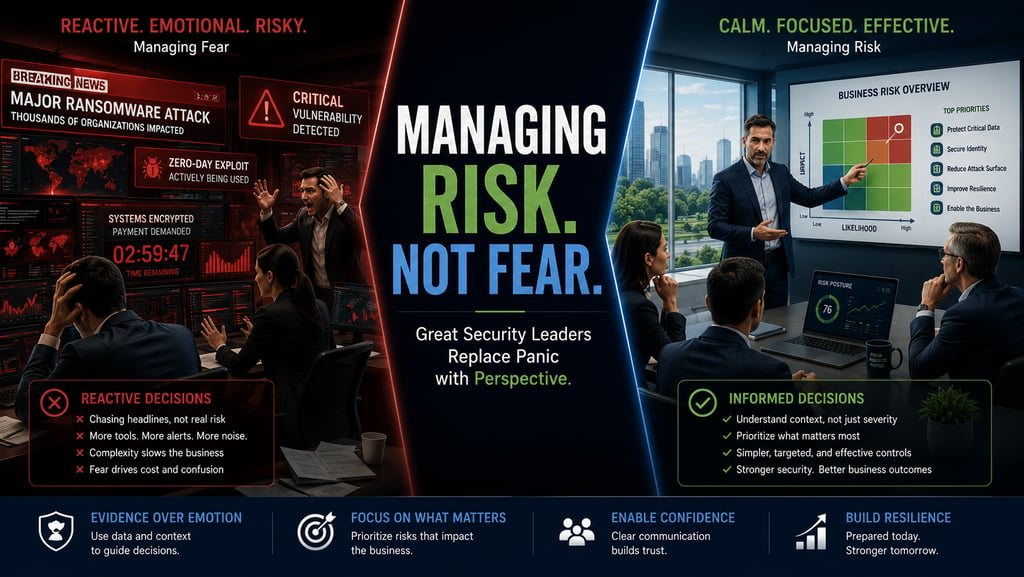
The news cycle never slows down. Every week seems to bring another urgent threat demanding immediate attention. The challenge isn't that these threats are imaginary, because many of them are real, rather, the challenge is that organizations often begin managing fear instead of managing risk.
Those are two very different things.
Risk management is a disciplined process. Fear management is an emotional reaction. Great security leaders know the difference.
Fear Is Immediate. Risk Is Measured.
As we all know, fear is emotional. It demands immediate action.
Risk, on the other hand, is analytical.
Risk will ask:
How likely is this?
What would the business impact be?
What controls already exist?
What is our actual exposer?
Fear says:
"Fix everything immediately."
Risk management asks:
"What matters most?"
The Loudest Risk Isn't Always the Biggest Risk
Every security leader has experienced it. We’ll see a high-profile breach that dominates the news cycle. Our executives will begin asking questions.
This may cause our budgets to shift, or our projects to change. Inevitably, meetings multiply, and always, we’ll be asked, are we next?
Sometimes those reactions are justified. Sometimes they are reactions to visibility rather than actual organizational risk.
Great leaders resist the temptation to chase headlines. They focus on protecting their own organization's most critical assets.
Fear Often Creates Complexity
Fear rarely tells us to simplify. Instead, it encourages most organizations to go out and get another tool, or add additional approval processes. Fear will drive you to ratchet up your existing policies and deploy another monitoring platform. Fear will require you to increase your reporting
Each of these decisions may feel like the correct thing to do in the interim.
Collectively, however, they often create unnecessary complexity.
It is this complexity that, I believe, leads to fear increasing the operational risk by making security harder to manage.
Risk Is About Business Context
The same vulnerability can represent vastly different levels of risk depending on the organization.
A critical vulnerability affecting an isolated lab system may pose relatively little business risk.
A medium-severity issue affecting an identity provider supporting every employee may deserve immediate attention.
This is where context matters most.
That's why mature organizations will prioritize based on business impact rather than technical severity alone.
Great Security Leaders Create Confidence
One of the most overlooked responsibilities of a security leader is creating confidence during uncertainty.
When incidents occur, everyone looks to leadership for answers and guidance. Naturally, we see employees look to their department or team leaders for what to do next. But outside of that, we also see that executives will look for leaders the same way that Board members will look for leaders. At this level, they don't expect certainty,
they expect clarity.
Strong leaders acknowledge uncertainty while providing a disciplined path forward.
Calm decision-making is contagious.
So is panic. No one wants panic in a crisis.
Managing Risk vs. Managing Fear
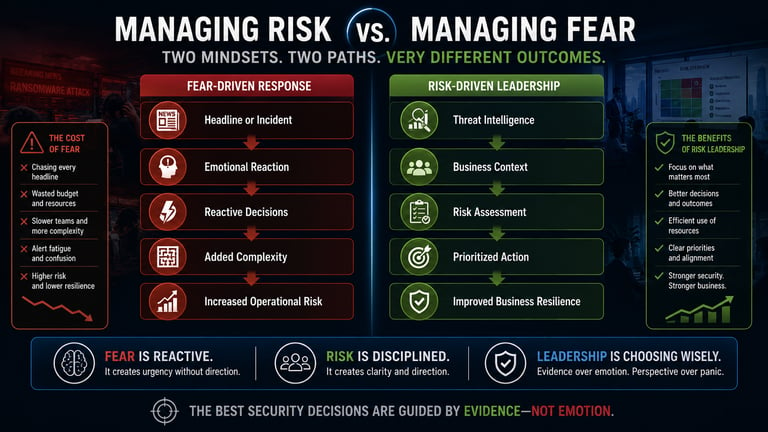
The best security decisions are guided by evidence—not emotion.
Risk Management Enables Better Decisions
The National Institute of Standards and Technology (NIST) emphasizes that risk management is a continuous process of identifying, assessing, responding to, and monitoring risk to support organizational objectives—not simply eliminating every possible threat. That principle reinforces the idea that cybersecurity decisions should be informed by mission priorities and business context rather than fear of the latest headline.
Effective organizations understand that not every vulnerability requires the same response.
Resources are finite.
Time is limited.
Leadership requires prioritization.
Security Should Reduce Anxiety, Not Create It
When it comes down to it, employees should feel empowered, executives should feel informed, and customers should feel confident.
A successful security program doesn't make people constantly worried about cyber threats. It helps them understand that risk is being managed thoughtfully and responsibly.
That's the difference between building confidence and spreading fear.
Great Security Leaders Ask Better Questions
Instead of asking: "How quickly can we implement another control?"
They ask: "Will this meaningfully reduce business risk?"
Instead of asking: "What does everyone else do?"
They ask: "What is appropriate for our organization?"
Instead of asking: "How do we eliminate all risk?"
They ask: "How do we manage risk within our organization's tolerance?"
These are the questions that produce better decisions.
Lets face it, cybersecurity will never be free from uncertainty.
New threats will emerge, technology will evolve, and attackers will always adapt.
The goal of security leadership isn't to eliminate uncertainty; rather, It's to help organizations navigate uncertainty with confidence.
Fear causes organizations to react. Risk management helps organizations make better decisions.
The strongest security leaders understand that difference.
And because they do, they build organizations that are not only more secure—but also more resilient.
Fear demands immediate action.
Leadership demands informed judgment.
Organizations that consistently outperform their peers aren't the ones that react the fastest.
They are the ones that make the best decisions under pressure.
Contact
Reach out for tailored security solutions.
© 2026. All rights reserved.