
The Difference Between Compliance and Security: And Why Confusing Them Creates Risk
Understanding the difference between being in compliance with a regulatory body and being secure.
Brian Gerard
4/13/20263 min read
The Critical Gap: Where Attacks Actually Happen
Most compliance frameworks map well to control domains. But attackers don’t attack frameworks. They exploit gaps in how controls are implemented, maintained, and operated.
Here’s what that looks like in practice:
Identity & Access Management
Frameworks like ISO 27001 and National Institute of Standards and Technology (NIST) require authentication controls, least privilege, and account management. However, attackers use techniques like password spraying, credential stuffing, and MFA fatigue attacks.
Gap: MFA may exist — but weak implementation or user behavior creates exposure.Vulnerability Management
Compliance requires regular scanning, a mature patching processes and remediation tracking. Attackers, on the other hand, exploit known vulnerabilities (CVEs), unpatched systems, and delayed remediation.
Gap: The organization is compliant on paper — but critical patches aren’t applied fast enough.Security Monitoring
Frameworks require log collection, monitoring processes, and incident detection. Attackers will use lateral movement, living-off-the-land techniques, and persistence mechanisms.
Gap: Logs exist — but detection and response are too slow to stop attackers.Third-Party Risk
Compliance requires vendor assessments and contractual controls. Attackers will exploit vendor credentials, trusted integrations, and supply chain access.
Gap: Vendors are assessed once — but risk evolves continuously.Security Awareness
Compliance requires annual training and awareness programs. Attackers use phishing, business email compromise, and impersonation.
Gap: Training is completed — but behavior doesn’t change under pressure.Cloud Security
Frameworks require secure configurations, access controls, and change management. Attackers will exploit misconfigured storage, excessive permissions and exposed APIs.
Gap: Policies exist — but real-world configurations drift.
All situations and setups are different, but really, a simple way to understand this, is to follow this logic:
An organization implements compliance controls --> they assume protection --> operational gaps exists within that assumed protection --> an attacker deploys techniques to find, and then exploit these gaps --> the organization is now responding to security incidents.
This is where most breaches occur: Between what is documented and what is actually happening.
Real World Examples
In the breach at Equifax, the organization had compliance processes in place. The failure was not a lack of controls. It was a failure to prioritize and remediate a known vulnerability in time. In the Capital One breach, cloud security controls aligned with industry standards existed. But a misconfiguration exposed sensitive data.
The pattern is consistent: Controls existed. Execution failed.
A better Way to Think About It
Compliance should be treated as The floor — not the ceiling. It establishes a baseline. Security builds on that baseline to address emerging threats, business-specific risks, and real-world attack scenarios. Organizations that mature their security programs move from:
“Are we compliant?” to “Where are we most at risk right now?”
The Role of Security Leadership
Security leaders must help the business understand the distinction. That means translating compliance gaps into business risk, prioritizing controls based on impact — not audit cycles, aligning security efforts with real threat scenarios, and ensuring continuous monitoring and response capabilities.
Compliance may satisfy auditors. But only security protects the business.
When Organizations Get This Right
When organizations separate compliance from security their audit readiness improves naturally. Risk visibility increases, response times improve, and ultimately, leadership gains clearer insight into exposure
At that point, compliance becomes a byproduct of good security, not the primary objective.
Compliance is necessary. But it is not sufficient. Organizations that rely on compliance alone are measuring whether controls exist. Organizations that prioritize security are measuring whether those controls actually work.
That difference is where risk lives.
A company passes its compliance audit. Excellent! Great Job!!! Every control is documented. Every checkbox is complete. Every requirement is met. Weeks later, the organization experiences a data breach. This happens more often than most leaders expect. Because compliance does not equal security.
And confusing the two can create a false sense of protection.
What Compliance Actually Means
Compliance is about meeting defined standards and regulatory requirements. Examples include ISO 27001, American Institute of Certified Public Accountants SOC 2, and Payment Card Industry Security Standards Council (PCI DSS) These frameworks establish baseline expectations for controls, documentation, and processes. They are important. But they are also periodic, standardized, and sorry to say it, backward-looking.
Compliance answers the question: “Did you meet the required controls at a point in time?”
What Security Actually Requires
Security is about managing real-world, evolving risk. It is continuous, adaptive, threat-driven, and business-aligned. Because of this focus, Security answers a different question: “Are we actually protected against current threats?”
And that answer can change daily.
Where Organizations Go Wrong
The problem begins when compliance is treated as the end goal. Instead of asking: “Are we secure?” Organizations ask: “Are we compliant?” That shift leads to behaviors like:
prioritizing audit readiness over risk reduction
implementing controls to satisfy requirements — not effectiveness
focusing on documentation instead of detection and response
This is often referred to as “checkbox security.”
Compliance vs Security: The Real Difference
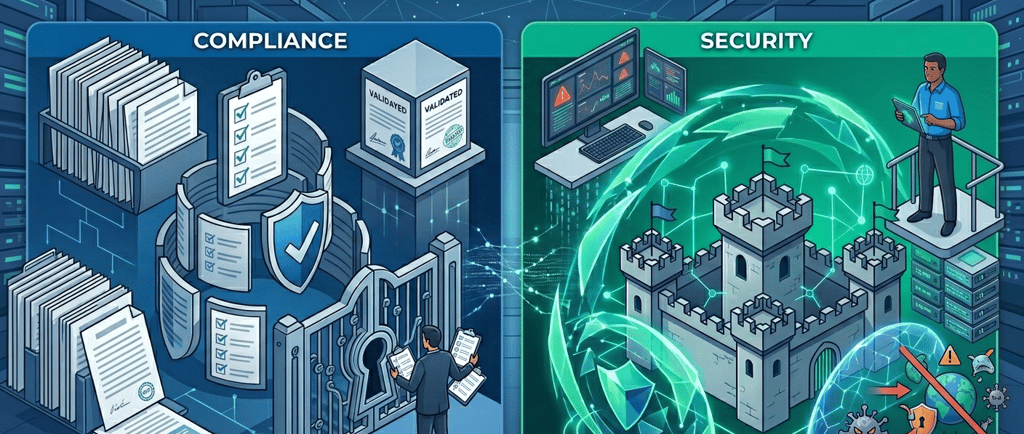
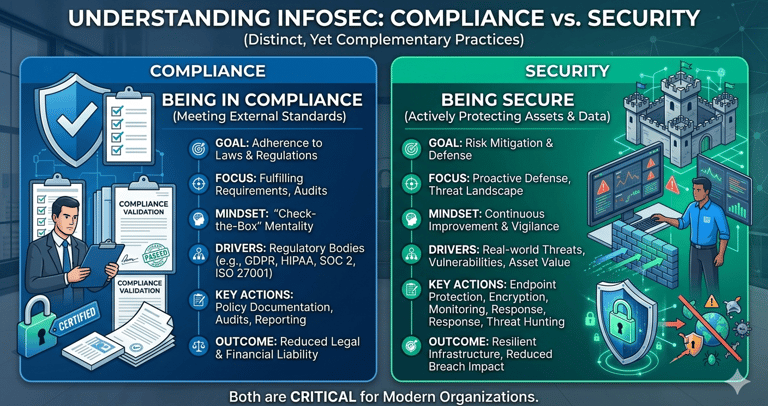
To understand the difference between compliance and security, we need to understand what each focus brings to the table. Compliance is a point-in-time, standard-driven, audit-focused discipline that is documentation heavy. While Security is continuous, threat-driven, risk-focused, while also being detection & response focused, and being adaptive to protection.
Contact
Reach out for tailored security solutions.
© 2026. All rights reserved.