
The Anatomy of a Modern Cyber Attack
Cyber attacks are not random. They follow patterns. The organizations that understand those patterns, and build defenses accordingly, are the ones that reduce risk most effectively.
Brian Gerard
5/4/20263 min read


Most people think cyber attacks start with sophisticated hacking. Zero-day exploits. Advanced malware. Highly technical intrusion techniques. In reality, many breaches begin much more simply: A phishing email. A reused password. A trusted vendor. And from there, attackers follow a predictable path.
Understanding that path is critical. Because you can’t effectively defend against something you don’t fully understand.
The “Single Event” Breach Myth
Cyber attacks are rarely a single action. They are a sequence of steps, each building on the last. Bad actors in general, and cyber attackers specifically, don’t just break in. They first gain access and can linger for a long period of time. They'll establish control, using techniques to elevate their credentials. From there, they will move within the environment and then extract value. Organizations that focus only on prevention often miss what happens after initial access.
A Real-World Perspective
In the breach involving Target, attackers initially gained access through a third-party vendor. From there, they moved laterally through the network until they reached payment systems. Similarly, the SolarWinds attack began with a supply chain compromise but expanded into widespread access across multiple organizations.
The pattern is consistent: Initial access is just the beginning.
The Five Stages of a Modern Cyber Attack
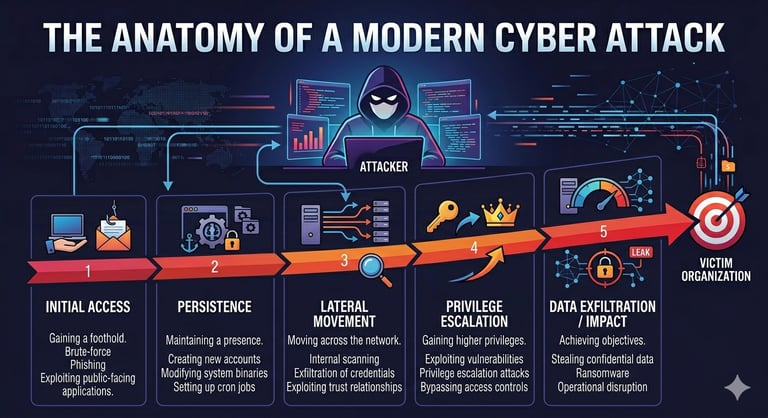
Modern cyber attacks follow a familiar playbook. The attackers will attempt to gain their initial access, and upon getting in, they'll want to stay in as long as needed. From there they'll move about the network, looking for interesting targets, elevelate their privileges as needed and then, when the time is right, exfiltrate anything they can to satisfy their objective. Lets take a closer look at each step along the way.
1. Initial Access
This is where attackers first enter the environment. Common methods that have been observed in the wild have included phishing emails, credential theft, the exploiting of known vulnerabilities, and even using compromised vendors This stage is often low-tech and highly effective.
2. Persistence
Once inside, attackers ensure they can maintain access. Their tactics may include actions like creating new accounts, or installing backdoors. They could even try their hand at modifying authentication mechanisms The goal is simple at this stage: Stay in the environment even if initial access is detected.
3. Lateral Movement
Attackers rarely find what they need immediately. No one creates identical folder/network structure. Attackers will move across systems to locate valuable assets. This often involves reusing credentials, exploiting trust relationships, and accessing shared systems as they find them. At this stage, visibility is critical, and it is often limited.
4. Privilege Escalation
To expand control, attackers will attempt to gain higher-level access. They will attempt to get administrative privileges, and then access to critical systems. They may possibly attempt to take control of any employed identity infrastructure. With elevated privileges, attackers can operate with fewer restrictions.
5. Data Exfiltration or Business Impact
This is the end goal. Depending on the attacker, this may involve data theft, ransomware deployment, any type of system disruption, or even political and financial fraud.
By this point, if the attackers have not been identified, they have most likely been been in the environment for days, weeks, or longer.
Where Most Defenses Break Down
Organizations often invest heavily in preventing initial access. But many attacks succeed because of gaps in detection speed or response capability. There may be internal visibility issues or gaps in identity governance. This is why metrics like time to detect (TTD) and time to respond (TTR) are far more meaningful than simply counting blocked attacks.
A More Effective Defense Mindset
Instead of asking: “How do we prevent attacks?” I would suggest that Security leaders should also ask questions like: "How quickly can we detect unauthorized activity?" "How effectively can we limit attacker movement?" And of course, "How resilient are we if a breach occurs?"
Because prevention alone is no longer enough.
The Role of Security Leadership
Security leaders must design programs that address the full attack lifecycle.
That means security leaders should be aligning controls to real attack paths. They should be improving visibility across environments, and strengthening identity and access management. Ultimately, security leaders should be constantly ensuring rapid detection and response, because attackers don’t operate in silos, and neither should security programs.
Cyber attacks are not random. They follow patterns. The organizations that understand those patterns, and build defenses accordingly, are the ones that reduce risk most effectively.
Because the goal isn’t just to stop attackers at the door. It’s to limit what they can do if they get inside.
Contact
Reach out for tailored security solutions.
© 2026. All rights reserved.