
Security Theater vs Real Security
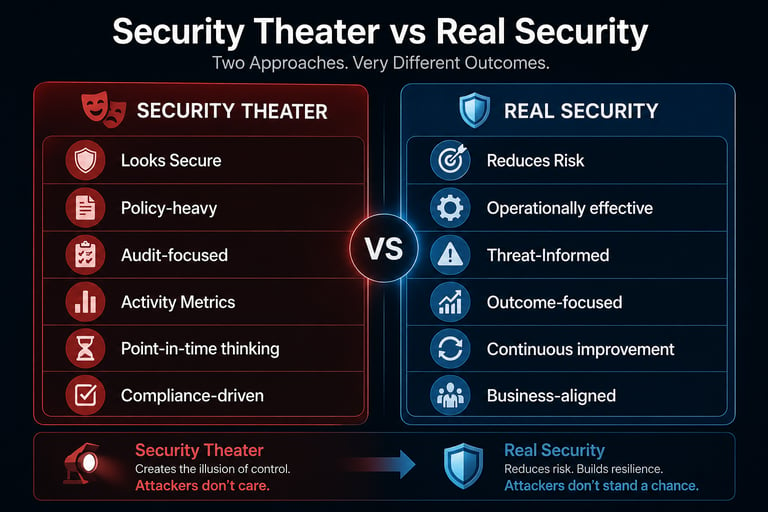
Security theater creates the appearance of protection. Real security reduces the likelihood and impact of attacks.
Brian Gerard
5/19/20263 min read
My post content
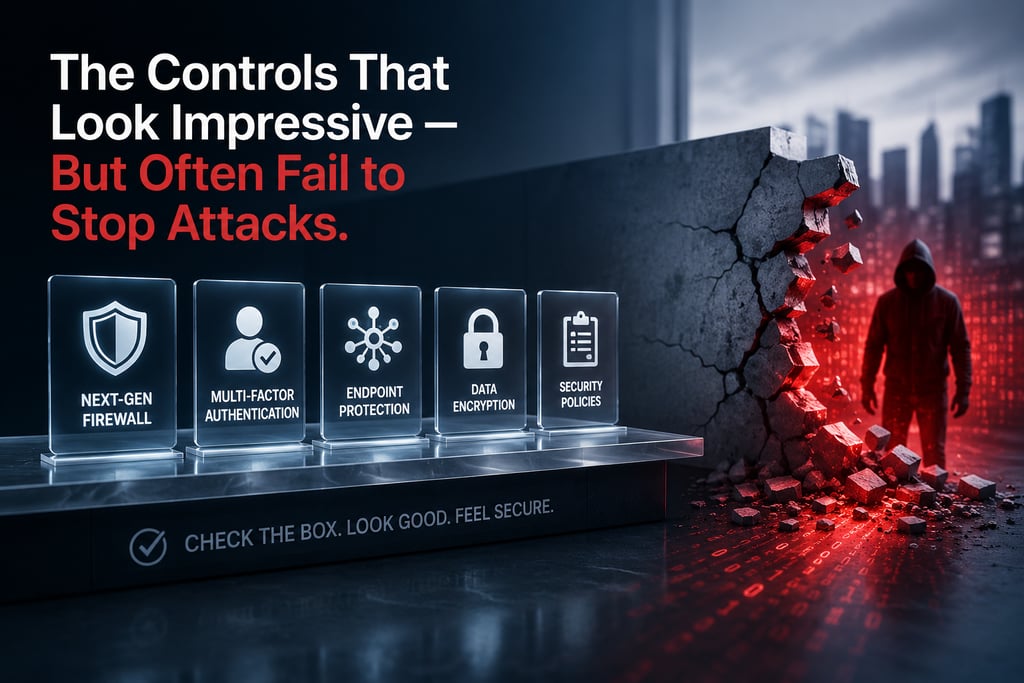
Some security controls exist primarily to make organizations feel secure. Not to actually stop attackers. The dashboard looks polished. The policies are documented. The compliance boxes are checked. Meanwhile, phishing attacks still succeed. Credentials are still compromised. And attackers still move laterally through environments. This is the difference between: security theater and real security.
And unfortunately, organizations may struggle to tell them apart.
What Security Theater Looks Like
A quick search to get my thoughts together on this subject, led me to Bruce Schneier, the author of the book Beyond Fear. In his book, Schneier explains security theater as a practice that an organization will take to implement security measures to provide the appearance of improved security, while actually doing little, or frankly, nothing at all, to achieve that objective. He goes on to include examples he found in airports and subway riding, as well as sporting events, but for our purposes in information security, the idea is the same.
Controls are put in place to prevent bad actors; but they are not implemented correctly, they are inconsistent, or they are largely symbolic with weak effectiveness.
Why Organizations Fall Into This Trap
Before I start pointing my finger and accusing full industries of cyber security malfeasance, have to point out that security theater is rarely intentional. It usually emerges because organizations are optimizing to pass an audit. They may be looking to reduce VISIBLE risk, and satisfy stakeholders as quickly as possible. In essence, they may just be checking those regulatory boxes to move on to other, more prominent business objectives.
However, the result of engaging in this activity leaves an organization without any meaningful resilience
Common Examples of Security Theater
1. Annual Security Awareness Training
Many organizations require employees to complete a once-per-year training module. The training is tracked. Completion rates are reported. But when a real phishing attack occurs?Employees still click. Why? Because awareness alone does not create behavioral change. Real security requires, ongoing reinforcement, more realistic simulations, and practical decision-making exercises. I should note that this one hurts as I've been involved in the creation of these annual training exercises. With certainty, I can say that out of those who took the training, it was inevitable that we would get a higher than expected percentage of failures when we deployed simulated phishing emails.
2. Complex Password Policies Without Modern Identity Controls
This is one that is also near and dear to my heart. For years, organizations enforced mandatory password changes, with highly complex password rules. And as such, employees responded predictably. They would write their passwords down on sticky notes, or they would reuse patterns, thus creating weaker behaviors. Meanwhile, attackers shifted towards credential theft, MFA fatigue attacks, and session hijacking. Modern identity protection depends more on MFA, on constant identity monitoring, with thought out conditional access, and strong authentication architecture. Not just password complexity.
3. Excessive Security Policies Nobody Reads
Some organizations maintain hundreds of pages of security policies. They are technically complete, yet, they are operationally ignored. Policies alone do not reduce risk. What matters is whether controls are understood, operationalized, and reinforced consistently.
4. Vulnerability Metrics Without Risk Prioritization
Reporting: “We have 1,200 critical vulnerabilities” may sound alarming. But without understanding what is being exploited, what is the business impact, and what is the level of internet exposure, the number itself provides little value. Real security focuses on which vulnerabilities actually matter most. If you want, check out my previous post on this topic here
Real-World Perspective
Major incidents involving organizations like Equifax and Target were not caused by an absence of security controls. The controls existed. The problem often came in the form of operational gaps, or ineffective prioritization. These were failures in execution with poor visibility into actual risk. This is an important distinction.
The Core Question Leaders Should Ask
Instead of asking: “Do we have this control?” Security leaders should ask: “Does this control meaningfully reduce risk against real attack behavior?” It's that single shift changes everything.
What Real Security Looks Like
Real security focuses on validated controls, measurable outcomes, attack-path reduction, rapid detection and response, and operational discipline. This prioritizes your effectiveness over optics.
Security leaders must resist pressure to optimize solely for appearances. They have to constantly be in the habit of validating whether controls actually work. They have to align investments to real threats. Security leaders need to be prioritizing operational maturity, and focusing on resilience instead of checkbox completion. Attackers do not care how polished a dashboard looks; they care whether gaps exist.
When organizations move beyond security theater their security investments will become more effective. Their risk visibility will improve. Their teams will begin to focus on meaningful priorities. Ultimately, their resilience increases significantly. At that point, security becomes a business capability and not just a compliance exercise.
Security theater creates the appearance of protection. Real security reduces the likelihood and impact of attacks. The difference is not found in how many controls exist. It is found in whether those controls actually work under real-world conditions.
Contact
Reach out for tailored security solutions.
© 2026. All rights reserved.