
Risk Registers Are Not Risk Management
Why Documenting Risk Is Easy and Managing It Is Hard
Brian Gerard
6/15/20263 min read
I've been a part of, and read about, organizations with beautifully maintained risk registers.
Every risk was documented. Every risk had an owner. The risks were scored and reviewed.
And yet...these organizations were still carrying significant unmanaged risk.
Why?
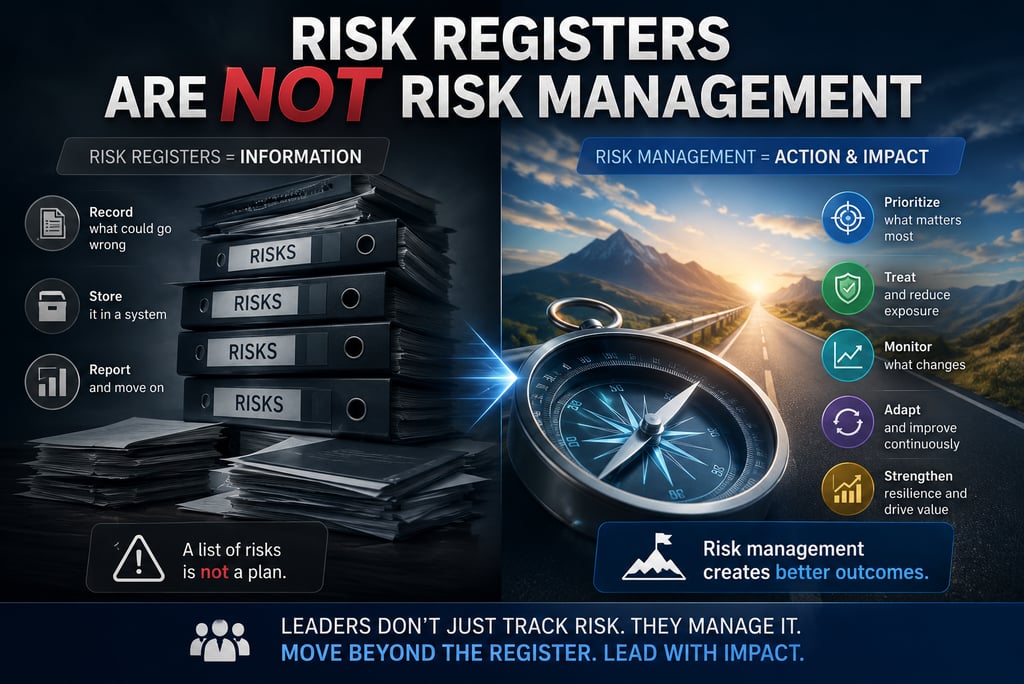
Documenting risk and managing risk are not the same thing.
A risk register is a tool.
Risk management is a discipline.
Confusing the two creates an impractical illusion of control.
Visibility Is Not Mitigation
One of the most common misconceptions in cybersecurity is: "If we know about the risk, we're managing it."
Personally, I would say, not so fast. Knowing that a risk exists does not reduce its likelihood. Knowing that a risk exists does not reduce its impact. Knowing that a risk exists does not improve resilience.
Awareness creates visibility.
Management creates outcomes.
What Real Risk Management Looks Like
Effective risk management answers some of the following questions that can, and very well do, extend beyond identification:
Can the risk be reduced?
Can the risk be transferred?
Can the risk be avoided?
Can the organization reasonably accept the risk?
These decisions require that a very distinct response plan be implemented. Not just documented.
The Checkbox Trap
Many organizations invest significant effort into maintaining risk registers. They will identify risks, categorize risks, and then score those risks. After that, they will conduct a review, and then generate reports based on the review.
These activities are important, but too often the process stops there. The register becomes the destination rather than the starting point. The result is a growing inventory of known risks with little meaningful change in actual exposure.
The Four Risk Responses
At its core, the field of professional risk management is about making decisions. As InfoSec professionals, we all know the four response strategies of risk: Avoidance, Reduction, Transfer, and Acceptance. As a refresher, let’s look at them a bit more, because these strategies are important in how organizations respond.
Avoidance
If an organization adopts this strategy, they alter their plans to eliminate the risk entirely. This is a conscientious decision to forgo anything that may pose a significant risk to the organization.
Reduction
This strategy means to create and implement controls to reduce the likelihood or impact of the risk. As an example, the organization may prioritize enhanced security tools and protocols to minimize breaches.
Transfer
This strategy involves shifting some of the financial exposure through insurance, contracts, or third-party agreements.
Acceptance
The organization will formally acknowledge the risk and proceed with informed understanding.
The critical point to understand is this: A risk is not managed simply because it appears in a spreadsheet, It is managed when an intentional decision has been made and executed.
The Real Danger of Risk Registers
Risk registers can unintentionally create false confidence. A documented risk often feels like a controlled risk. Unfortunately, attackers do not care whether a risk has been documented.
Attackers care whether the underlying weakness still exists.
If we look at risk from an adversary's perspective, we will see that an unpatched system is still unpatched. That excessive privileges are still excessive. Weak vendor oversight remains weak vendor oversight.
The register changes nothing unless action follows.
A Practical Example
Consider a vendor risk assessment that identifies insufficient security controls, limited incident response capabilities, and weak authentication practices.
The risk is logged. A score is assigned. The risk appears in quarterly reporting.
Twelve months later…
Nothing has changed.
The organization is now better informed—but not better protected.
That is documentation. Not risk management.
Why Executives Care
If you’ve read my previous articles, you already know Executives rarely ask: "How many risks are in the register?"
They ask questions like:
Which risks matter most?
What are we doing about them?
Are we reducing exposure?
How does this affect the business?
These questions focus on outcomes that affect the business. Not documentation.
What Strong Security Leaders Do Differently
Strong security leaders understand that risk registers are valuable tools.
They also understand their limitations.
They will focus on ownership and accountability. They will focus on treatment plans and measurable progress.
Remember, the goal is not to create visibility, rather, the goal is to reduce uncertainty and improve decision-making.
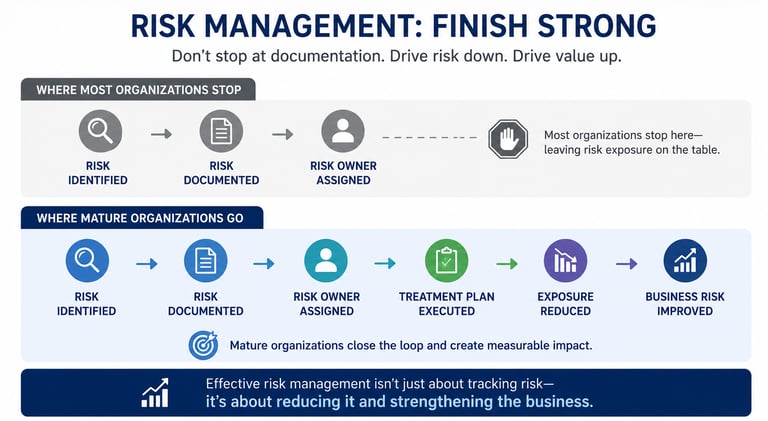
Most organizations stop at step three. Mature organizations continue to the end.
When Risk Management Works
Organizations that manage risk effectively tend to prioritize more effectively and allocate resources more efficiently. They communicate more clearly with their leadership while reducing meaningful exposure. These organizations, over time, improve their resiliency.
Continuing with our thread, most importantly, they move beyond tracking risk, and begin reducing risk.
A risk register is one of the most useful tools in cybersecurity governance. But it is only a tool. By itself, it does not reduce risk. It does not improve resilience. It does not stop attacks. Risk management begins where the register ends. The organizations that understand this distinction are often the ones that make the greatest progress toward meaningful risk reduction.
Contact
Reach out for tailored security solutions.
© 2026. All rights reserved.