
My 25 Years In Technology: Lessons the Industry Still Grapples With
Experience Changes the Way You See Risk
Brian Gerard
5/26/20264 min read

My post content
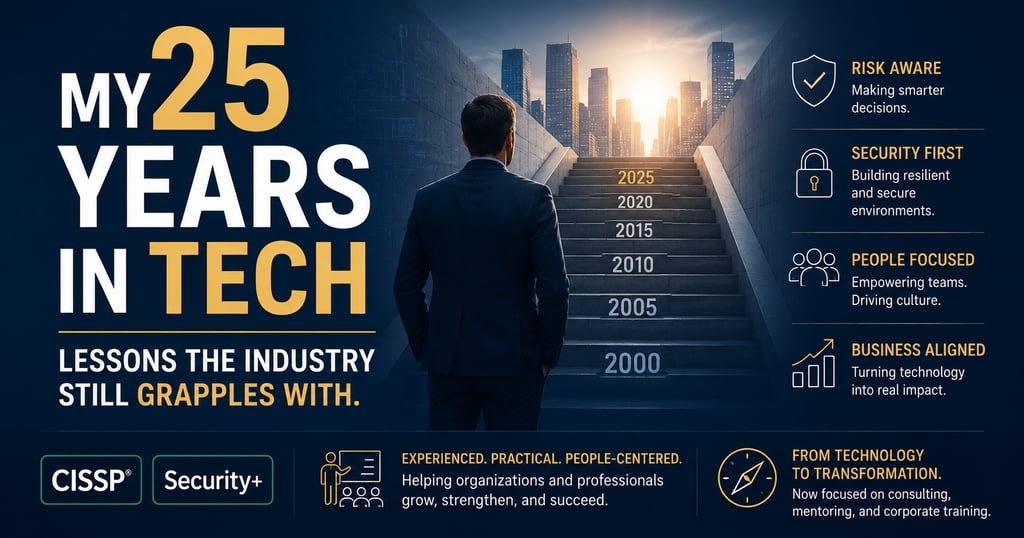
My 25 Years In Technology: Lessons the Industry Still Grapples With
Experience Changes the Way You See Risk
With more than 25 years in technology and more recently in Information Security, I’ve come to an uncomfortable conclusion: Many organizations are still struggling with the same fundamental security problems they faced years ago.
Technology has evolved. Tooling has evolved. The threats have evolved.
But many of the underlying issues remain remarkably consistent. Things like poor risk prioritization and weak operational discipline. Security being disconnected from the overall business strategy. An overreliance on tools, and and underinvestment in culture and governance. The longer you work in this field, the more you realize: Most major security failures are not caused by a lack of technology; they are caused by failures in execution, alignment, and decision-making.
1. Compliance Still Gets Confused With Security
One of the most persistent misconceptions in the industry is the belief that: Compliance equals security. It doesn’t.
Organizations can, and often due, pass their audits, they complete their assessments, and they document controls…and yet, they still remain highly vulnerable. Compliance simply establishes a baseline.
Security requires continuous adaptation, operational maturity, and real-world threat awareness. Attackers do not care whether an organization passed an audit.
2. Security Is Still Too Technically Focused
Many security teams communicate almost entirely in technical language, and I can attest that I’ve been guilty of the same. We stack CVEs and rate vulnerabilities while looking at indicators and reading the outputs from our tools. Meanwhile, executives are thinking about operational disruption, and revenue impact. They think about their regulatory exposure and organizational resilience. Security teams that cannot translate technical risk into business impact often struggle to gain executive alignment.
3. Organizations Continue to Underestimate Human Behavior
Over the years, attack techniques have evolved significantly. But one thing has remained remarkably effective: social engineering Why? Because attackers understand something many organizations still overlook: People are part of the attack surface!
Fear-based security cultures, weak reporting environments, and poor communication continue to create unnecessary exposure. Technology alone cannot solve behavioral problems.
4. Complexity Is Often the Enemy of Security
Many environments have become overly complicated. They have become fragmented and difficult to monitor. They are inconsistent in their operations. This complexity creates visibility gap, configuration drift and inconsistent controls. This leads to a delayed response capability
Ironically, some organizations become less secure as their environments become more “advanced.” A mature security program is often about clarity, consistency, and operational discipline.
5. Identity Is Now the Primary Battleground
Years ago, organizations focused heavily on perimeter security. Think firewalls in their data center and nothing more. Today, attackers are increasingly targeting identities, credentials, authentication workflows, and trust relationships.
Modern attacks less frequently begin with malware, rather they are more frequently beginning with techniques that involve stolen credentials, MFA fatigue, phishing, and session theft.
Identity security is no longer just an IT function. It is foundational to enterprise resilience.
6. Many Metrics Still Measure Activity Instead of Risk
When you look at security dashboards, they frequently emphasize alert volume, blocked attacks, vulnerability counts, or training completion percentages.
These metrics often fail to answer critical questions like “Are we becoming more resilient?” Or “Can we detect attacks faster?” Or even, “Can we reduce business impact?”
Security metrics should support business decisions and not just reporting.
7. Third-Party Risk Is Still Underestimated
Organizations continue expanding vendor integrations, SaaS adoption, supply chain dependencies, and external partnerships. Every one of those relationships expands the attack surface.
Yet many vendor risk programs remain heavily questionnaire-driven (antiquated DDQs with limited context). They are point-in-time focused. They are operationally shallow.
Attackers increasingly exploit trusted relationships because they understand vendors often provide the easiest path inward.
8. Security Culture Still Matters More Than Most Organizations Realize
Some organizations invest heavily in tools while neglecting culture entirely.
But culture influences reporting behavior. The culture dictates the escalation speed, and the policy adoption. Ultimately, it is the culture that drives decision-making and accountability
Employees who fear blame are less likely to report mistakes quickly. That delay alone can dramatically increase breach impact.
Strong security cultures create visibility, they create trust. This will lead to faster response and shared responsibility.
9. Prevention Alone Is No Longer Enough
For years, security strategies centered heavily on prevention. But modern security leadership increasingly recognizes that some attacks will succeed.
The real differentiators are: detection speed, response effectiveness, containment capability, and organizational resilience
The question is no longer: “How do we stop every attack?” The question is: “How effectively can we limit impact?”
10. Security Must Align With Business Strategy
This may be the most important lesson of all.
Security that operates independently from business priorities eventually becomes reactive, disconnected, difficult to justify, and unfortunately, less effective.
The strongest security programs understand organizational objectives. They understand operational realities and business risk tolerance. When it comes down to the bottom line, a strong security program understands leadership priorities. At that point, security becomes: a business enabler not just a technical function.
After more than two decades in technology and security, one lesson stands above the rest:
Technology matters. But leadership, culture, operational maturity, and business alignment matter just as much (and sometimes more).
The organizations that consistently reduce risk are rarely the ones with the most tools.
They are the ones that get it! They prioritize effectively. They execute consistently. They communicate clearly. They adapt continuously. Because cybersecurity is no longer just about protecting systems.
It’s about enabling organizations to operate securely in an increasingly complex world.
Contact
Reach out for tailored security solutions.
© 2026. All rights reserved.