
How Security Leaders Communicate Risk to Executives
If you're not able to translate the risk to the bottom line, you're just creating noise.
Brian Gerard
4/20/20262 min read


Stop me if you've heard this one before: A security leaders walks into an executive meeting and says "We have 1,200 critical vulnerabilities, multiple unpatched systems, and what appears to be an increase in threat activity." The Executives nod...the meetings moves on. Not a single decision is made, no additional funding is approved, and unfortunately no urgency is created.
The message given is technically accurate in this instance, however, the data being presented to the executives in the room failed to answer the only question that that every security-minded team member, from junior analyst to leader needs to understand:
"What does this mean for the business?"
The Core Problem
On one hand, InfoSec professionals are trained to think in terms of vulnerabilities, threats, controls, and technical severity. On the other hand, Executives think in terms of financial impact, operational disruption, regulatory exposure, and of course, reputational risk. When the communication style is presented as technical, alignment breaks down. And when alignement breaks down, risk increases!
Executives don’t need more data. They need decision-ready insight. This means they need Security Leadership that can translate security issues into:
potential business impact
likelihood of occurrence
urgency of action
trade-offs and options
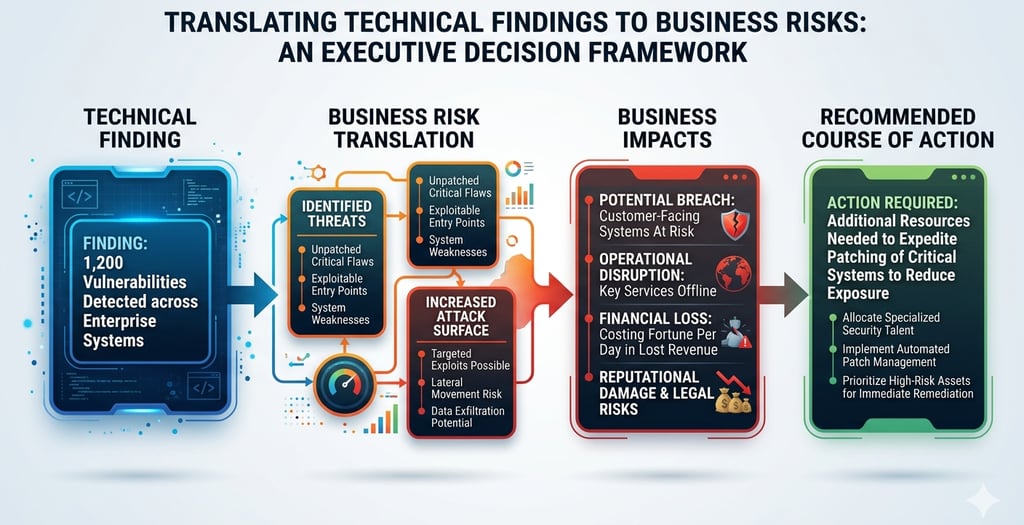
Instead of saying: “We have critical vulnerabilities” You should say: “If exploited, these vulnerabilities could disrupt our customer-facing systems and impact revenue during peak operations.” That will turn the conversation to something way more productive.
In my opinion, a simple framework for communicating on an executive level should look like this:
Technical Finding --> Threat Context --> Business Impact --> Decision Required
When presenting security issues, the conversation should move in this direction. If it doesn't reach the "decision required," it won't drive an action.
What Strong Security Communication Looks Like
Instead of: “We’re seeing increased phishing attempts.” Say: “We’re seeing increased phishing attempts targeting finance. If successful, this could lead to fraudulent transactions. We recommend implementing additional verification controls.”
Instead of: “We need to improve logging.” Say: “Current logging gaps may delay detection of a breach, increasing recovery time and potential business impact.”
Clarity creates urgency.
When This Is Done Well
When security communication is aligned with business strategy, executives engage more actively. Funding conversations will become easier. Decisions happen faster, and security becomes part of strategic planning. At that point, security is no longer reactive.
It becomes proactive and influential.
Security risks don’t become business priorities on their own. They become priorities when they are clearly understood. The most effective security leaders don’t just identify risk. They ensure it is communicated in a way that drives action.
How does your organization communicate cybersecurity risk to executive leadership? What approaches have been most effective?
Contact
Reach out for tailored security solutions.
© 2026. All rights reserved.