
Five Security Controls That Stop Most Attacks
The organizations that focus on fundamentals, and execute them well, consistently reduce risk more effectively than those chasing complexity alone.
Brian Gerard
5/11/20263 min read
The Basics Still Matter More Than Most Organizations Think
Cybersecurity often feels overwhelmingly complex. New threats emerge daily. Attack techniques constantly evolve. Security products flood the market. And yet…
Many successful breaches still exploit the same fundamental weaknesses: weak identity, controls, unpatched systems, poor visibility, excessive access, and human error.
In other words: most attacks succeed because basic security controls fail; not because attackers used advanced techniques.
The Industry’s Biggest Mistake
Many organizations chase complexity before mastering fundamentals. They invest in advanced platforms, AI-driven tooling, and highly specialized solutions. Meanwhile, attackers continue succeeding through techniques like phishing, stolen credentials, exploiting known vulnerabilities, and misconfigurations. The uncomfortable reality is if you utilize strong foundational controls, you will stop a significant percentage of real-world attacks. Let's take a look at a few of those controls
1. Multi-Factor Authentication (MFA)
If there is one control that consistently reduces risk across environments, it is MFA. Why? Because compromised credentials remain one of the most common attack vectors.
Attackers will employ their go-to tools of phishing, credential stuffing, password spraying, and reused passwords. MFA dramatically reduces the effectiveness of those techniques.
Real-World Relevance
Incidents involving organizations like Uber demonstrated how identity attacks continue to dominate modern breaches. While MFA is not perfect, environments without strong identity protections remain highly vulnerable.
2. Effective Patch & Vulnerability Management
Many organizations are breached through vulnerabilities that were already known — and often already patched by vendors. The challenge is usually not awareness. It’s prioritization, speed, operational discipline
The Critical Shift
Security leaders should focus less on“Total vulnerabilities” and more on exploitable vulnerabilities, their internet-facing systems, and of course securing their business-critical assets. Not all vulnerabilities carry equal risk.
3. Least Privilege Access
Attackers thrive in environments with excessive permissions. Once inside, they look for opportunities to move laterally. They will escalate privileges where possible, and then they will access sensitive systems. Least privilege reduces the blast radius.
A Simple Principle
Users, and systems, should only have access necessary to perform their functions.
Nothing more. This becomes especially important in cloud environments, identity systems, and administrative accounts
4. Security Logging & Monitoring
Many organizations collect logs. Far fewer organizations effectively use them. Visibility is critical because prevention alone will eventually fail. The organizations that reduce impact are often the ones that can detect abnormal behavior quickly, correlate activity effectively, and respond rapidly.
What Matters Most
Logging without monitoring creates noise.
Monitoring without response creates delay.
Security maturity requires both.
5. Security Awareness That Changes Behavior
Annual training alone does not stop attacks, behavior does. Effective awareness programs focus on a few specifics like real-world scenarios, phishing recognition, reporting confidence, and practical decision-making. Attackers increasingly target the people within the organization, not just the technology.
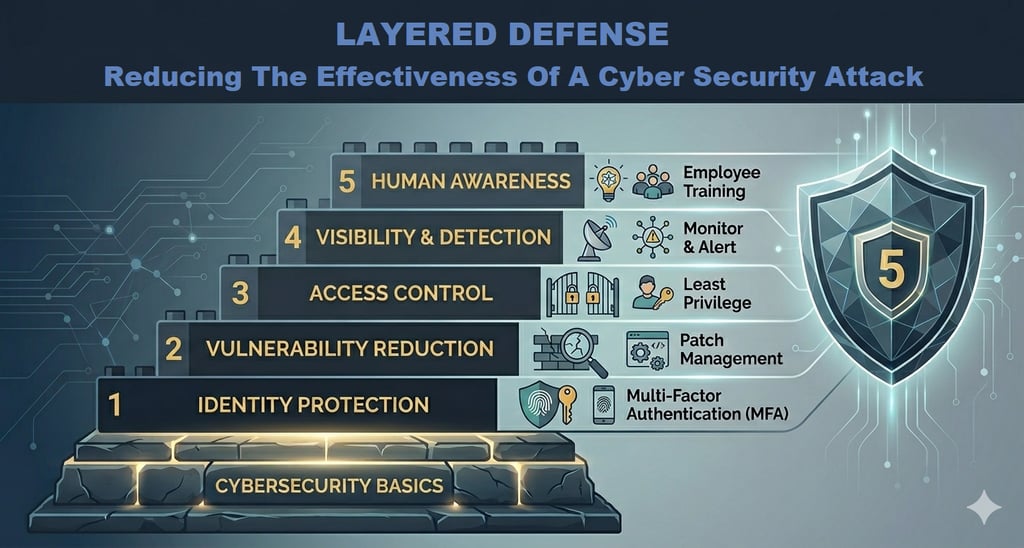
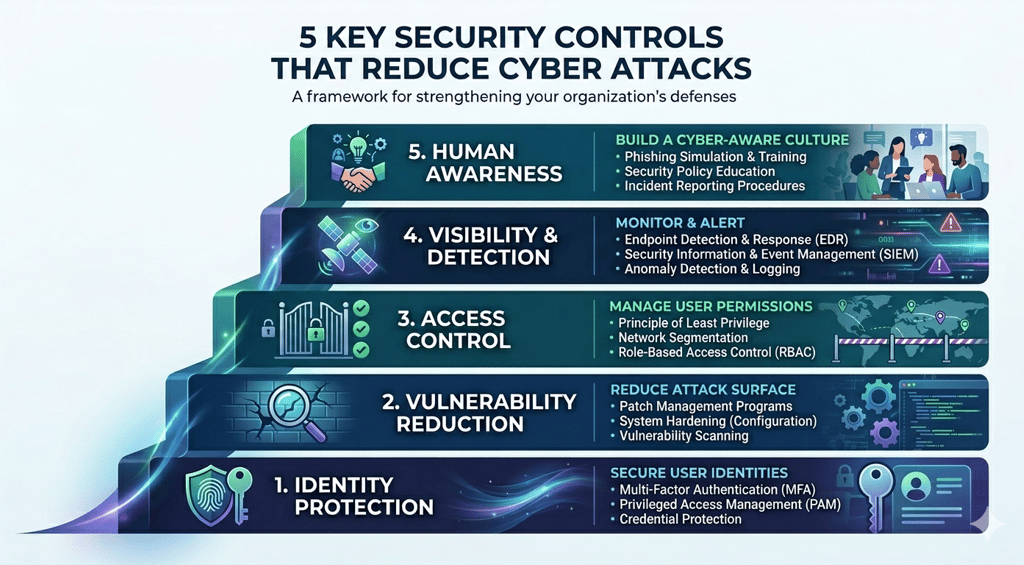
The Five Key Security Controls Framework
Identity Protection: This is your foundation—ensuring that the people accessing your systems are who they say they are through MFA and credential management.
Vulnerability Reduction: This layer focuses on "hardening" the environment by patching holes and reducing the available attack surface.
Access Control: Once an identity is verified, this control ensures they only have access to the specific data and systems required for their role.
Visibility & Detection: This serves as your "eye in the sky," using tools like EDR and SIEM to spot and alert you to suspicious activity in real-time.
Human Awareness: The final, critical layer—empowering your workforce to be the last line of defense through training and a culture of security.
The Role of Security Leadership
Security leaders must balance innovation with operational discipline.
Ensuring foundational controls that are implemented consistently and measured effectively, while developing controls that are aligned with business risk and that are continuously validated, matures your overall security program. Mature security programs are rarely built on a single advanced tool. They are built on strong operational fundamentals.
When Organizations Get This Right
When foundational controls are mature, attack surfaces shrink. Detection improves. The response becomes faster. Overall resilience increases. At that point, organizations are no longer relying solely on prevention. They are building defense in layers!
Cybersecurity does not always fail because organizations lack advanced technology. Often, it fails because basic controls were incomplete, inconsistent, or poorly maintained. The good news is this: Many attacks are still highly preventable.
The organizations that focus on fundamentals, and execute them well, consistently reduce risk more effectively than those chasing complexity alone.
Contact
Reach out for tailored security solutions.
© 2026. All rights reserved.