
Cybersecurity Isn't an IT Problem Anymore
Why Cybersecurity Has Become a Business Leadership Responsibility
Brian Gerard
7/27/20263 min read
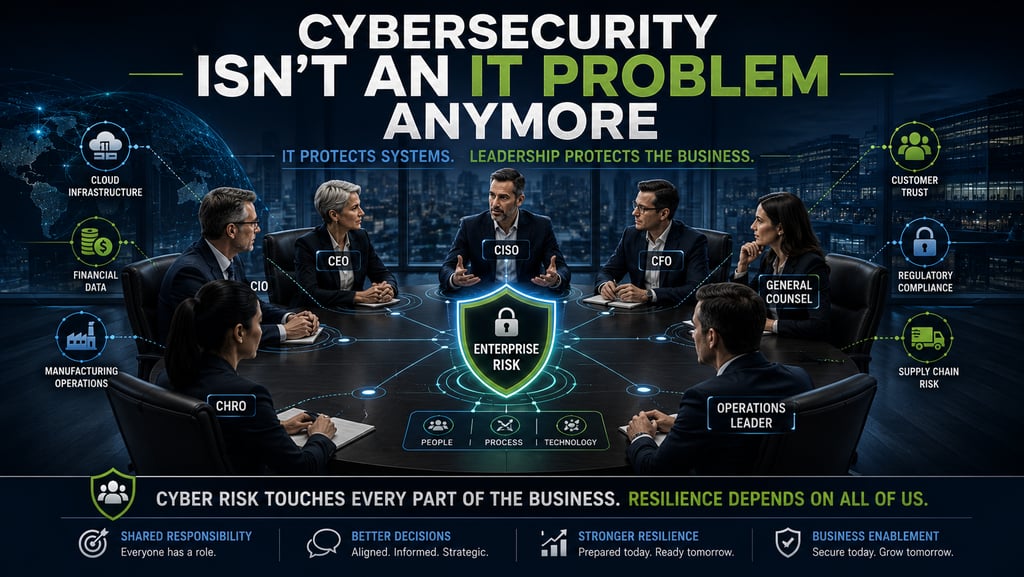
For decades, cybersecurity was viewed as a technology issue.
If something broke, IT fixed it. If a firewall needed upgrading, IT handled it. If antivirus software needed updating, IT deployed it.
That mindset no longer reflects reality.
Today's most significant cyber risks don't stop at servers, laptops, or networks.
They affect revenue.
Customer trust.
Regulatory compliance.
Business operations.
Corporate reputation.
Shareholder confidence.
Cybersecurity is no longer an IT problem.
It's a business leadership responsibility.
Technology Is Only One Piece of the Risk
Ask yourself these simple questions.
When ransomware shuts down a hospital, is the biggest problem the encrypted servers?
Or is it delayed patient care?
When attackers steal customer data, is the biggest issue the compromised database?
Or is it the loss of customer trust?
When a manufacturer experiences a cyberattack that halts production, is the real problem the malware?
Or is it the disruption to the supply chain and missed contractual obligations?
Technology may be the point of failure.
Business impact is the real consequence.
Every Business Function Owns Cyber Risk
Modern organizations depend on technology to achieve nearly every strategic objective.
This means that every department contributes to cybersecurity.
Finance manages payment fraud risk.
Human Resources protects employee information.
Legal guides privacy and regulatory compliance.
Procurement evaluates third-party vendors.
Ops ensures resilience.
Executive leadership establishes priorities.
The security team cannot manage enterprise risk alone.
It enables the organization to manage risk together.
Cybersecurity Is a Governance Function
One of the biggest misconceptions that I’ve seen in our profession is that cybersecurity belongs exclusively within IT.
Technology implements controls.
Governance determines priorities.
Leadership allocates resources.
The board establishes risk tolerance.
Executives decide which risks are acceptable.
Security provides the information necessary to make those decisions.
That isn't an IT function. It's governance.
The 2024 NIST Cybersecurity Framework (CSF 2.0) reinforces this evolution by introducing Govern as a core function, emphasizing that cybersecurity outcomes depend on organizational leadership, governance structures, and business context—not technology alone.
Business Leaders Already Manage Risk
Every executive manages uncertainty.
The CFO manages financial risk. The General Counsel manages legal risk. The COO manages operational risk.
Cybersecurity should be viewed no differently.
The objective isn't to eliminate risk. It's to understand it, to prioritize it, and to effectively communicate it.
Furthermore, the objective is to manage it within the organization's tolerance.
Cybersecurity Enables the Business
A damaging myth that I've observed in cybersecurity is that security slows innovation.
I would argue that poorly designed security programs are the real ghost in this machine.
My counterpoint is that strong security programs accelerate innovation!
When security is embedded early in projects, organizations can adopt new technologies with greater confidence.
Products get launched faster. Expansion into new markets happens more securely. This can lead to stronger customer relationships.
Security doesn't compete with the business, and if you’ve read any of my previous articles, I believe that security enables the business!
Leadership Changes the Conversation
Notice the difference between these two statements.
IT Perspective
"We need to deploy multifactor authentication."
Business Perspective
"We're reducing the likelihood of account compromise that could interrupt operations, expose customer data, and create regulatory risk."
See, the technology is identical.
However, the conversation is entirely different.
That's the difference between managing technology and leading security.
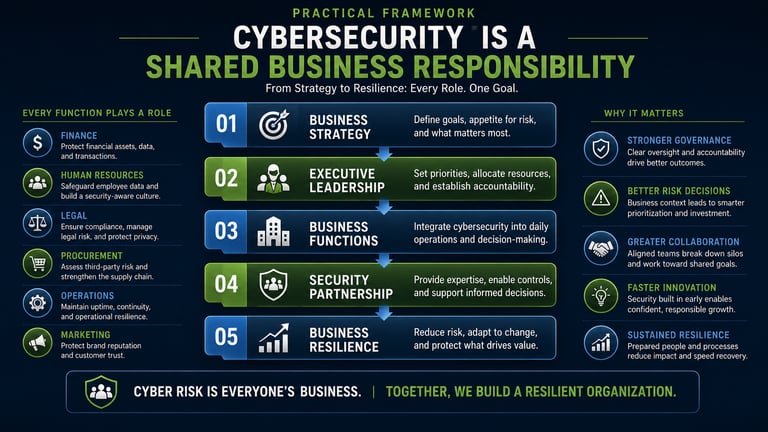
Cybersecurity succeeds when every part of the organization understands its role in managing risk.
Why Boards Care More Than Ever
According to the 2024 World Economic Forum Global Cybersecurity Outlook, cyber risk is increasingly viewed as an enterprise-wide challenge requiring stronger governance, executive engagement, and organizational resilience rather than purely technical controls.
Boards are asking different questions than they did a decade ago.
Not:
"Which firewall are we using?"
But:
How resilient are we?
What are our greatest business risks?
How prepared are we for disruption?
What decisions require board involvement?
Those are governance questions.
Great Security Leaders Build Business Relationships
The strongest security leaders don't spend all of their time with technology teams.
They spend time understanding:
Business objectives.
Operational challenges.
Growth initiatives.
Regulatory pressures.
Customer expectations.
Because when security understands the business, security decisions become better business decisions.
Cybersecurity has evolved.
The role of the security leader has evolved with it.
Organizations no longer need leaders who simply understand technology.
They need leaders who understand how technology supports business strategy.
Because cyber incidents don't just interrupt systems.
They interrupt organizations.
And organizations aren't led by IT alone.
They're led by people.
Contact
Reach out for tailored security solutions.
© 2026. All rights reserved.