
Building Trust Between Security and the Business
Why the Strongest Security Programs Are Built on Relationships, Not Resistance
Brian Gerard
7/13/20264 min read
My post content
When you're in the office, or in your next Teams meeting, ask your coworkers what they think of the infosec team, and the answers may sound familiar to the following:
"They're the department that says no."
"Everything takes longer because of security."
"Security doesn't understand how we work."
Those perceptions are rarely created overnight. They develop through repeated interactions where security is viewed as an obstacle rather than a partner.
The irony is that every security leader shares the same goal as the rest of the business, which is to help the organization succeed.
The difference is that security often measures success by reducing risk, while business leaders measure success by delivering results.
The organizations that excel at cybersecurity recognize these goals are not in conflict. They are complementary.
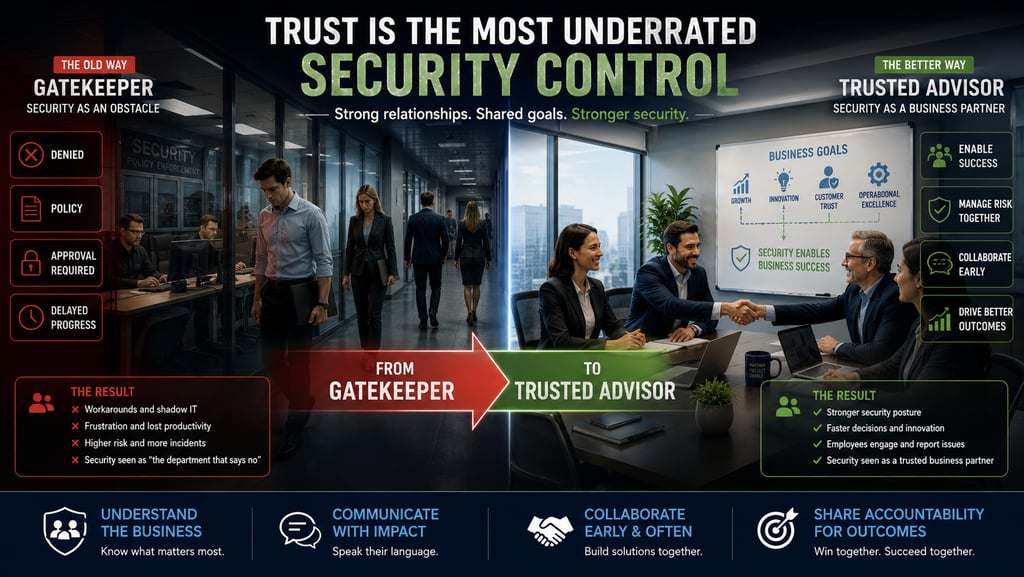
Trust Is the Most Underrated Security Control
Security Is a Service Organization
Many security teams unintentionally position themselves as gatekeepers.They will, per policy, review requests, and deny the exceptions. They will enforce policy and implement controls. While this governance is essential, leadership requires something more.
The best security organizations see themselves as internal business partners.
Their role isn't simply to enforce policy. Its role is to help the business achieve its objectives securely.
The conversation changes when that is understood.
Trust Is Built Before the Incident
One of the most important relationships a security leader builds is with people outside the security department.
Think about it…
During a cyber incident, trust cannot be created, It must already exist. A cyber incident is no place to strike up a conversation and talk about non sequiturs. Security team members must have already established that they are capable of looking out for the business’ best interests with growth in mind.
If business leaders know security as collaborative, transparent, and pragmatic, they're far more likely to involve the team early in strategic initiatives as well.
If security is known only for saying "no," it will often be brought in after critical decisions have already been made.
Why Employees Bypass Security
Employees rarely bypass security because they dislike it. More often, they believe it's the fastest way to accomplish their work. How many times have you been in a situation where your fellow employee bypassed policy to get something done more efficiently…or at least it's what they perceived to be, as more efficient?
If security processes are overly complicated, people naturally seek workarounds.
Shadow IT.
Shadow AI.
Personal file-sharing services.
Unapproved collaboration platforms.
These behaviors are often symptoms of friction rather than malicious intent.
Strong security leaders don't simply ask: "Who violated the policy?"
They ask: "Why did our process encourage this behavior?"
Trust Reduces Risk
Trust isn't just good for culture.
It's good for security.
The 2024 Verizon Data Breach Investigations Report found that 68% of breaches involved a human element, while also highlighting that organizations with stronger security cultures are seeing more employees voluntarily report phishing attempts and mistakes instead of hiding them. That kind of transparency gives security teams the opportunity to respond more quickly and reduce overall business impact. (Verizon)
When employees trust the security team, they are more likely to:
Report suspicious emails.
Escalate potential incidents quickly.
Ask questions before adopting new technologies.
Seek guidance instead of finding workarounds.
Every one of those behaviors reduces organizational risk.
Great Security Leaders Speak the Language of the Business
Trust grows when people feel understood.
Instead of saying: "You can't use that application because it violates policy."
Try:
"Let's find a solution that enables your project while protecting customer data."
When you communicate that way, its not changing the objective, its changing how to converation evolves.
Business leaders rarely object to security. They object to unnecessary obstacles.
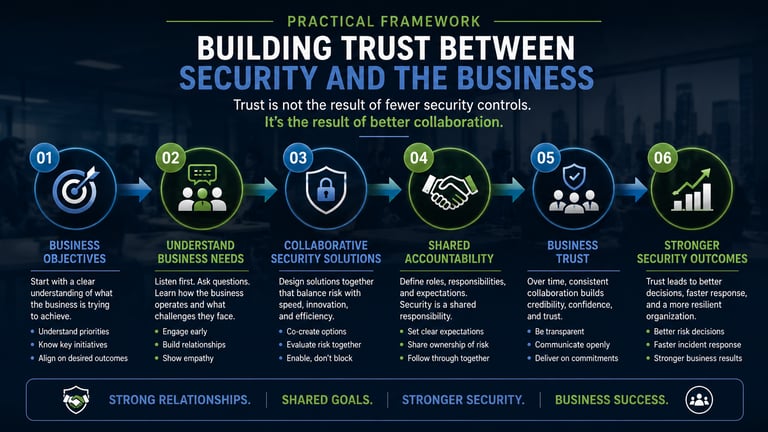
Trust is not the result of fewer security controls. It's the result of better collaboration.
Trust Is Earned Through Consistency
Trust isn't built during annual awareness training. It's built through hundreds of daily interactions. Simple things like responding respectfully, or explaining decisions clearly. You can build trust by being transparent about risk and admitting uncertainty when necessary. When you follow through on your commitments, and follow through consistently, this goes a long way to build credibility....
Credibility builds trust.
Trust builds influence.
Security Culture Starts with Security Teams
Organizations often expect employees to embrace security culture. But culture begins with leadership.
Microsoft has emphasized that building a lasting security culture requires embedding security into everyday business operations, strengthening governance, and treating security as a shared organizational responsibility rather than the responsibility of one department. (Microsoft)
When security teams become approachable, responsive, and invested in business success, they're far more likely to influence behavior across the organization.
Great Security Leaders Become Trusted Advisors
The strongest security leaders don't wait to be invited into important conversations. Business leaders invite them.
They do this not because they're required to, nut because they trust their judgment.
Trusted advisors don't simply identify problems. They help solve them. They understand business priorities. They balance risk with opportunity. They help leaders make informed decisions.
That's influence.
And influence is one of the most valuable security controls an organization can have.
Technology can detect attacks. Controls can reduce vulnerabilities. Policies can establish expectations. Trust determines whether people engage with security, or work around it.
The strongest security programs aren't built on fear. They aren't built on enforcement alone.
They're built on relationships.
In the end, cybersecurity has always been about protecting people, enabling the business, and making better decisions together.
Contact
Reach out for tailored security solutions.
© 2026. All rights reserved.