
Building a Security Culture Instead of Security Fear
You can invest in the best tools and controls available. But if employees are afraid to engage with security, those controls will always have gaps.
Brian Gerard
4/27/20263 min read
My post content
An employee receives a suspicious email. They hesitate. Not because they don’t recognize the risk…but because they’re unsure what will happen if they report it. Will they be blamed? Will it escalate into something bigger? Will it reflect poorly on them?
So they do nothing.
This is how small risks turn into major incidents. Not because employees don’t care — but because the culture around security discourages action.
The Problem With Fear-Based Security
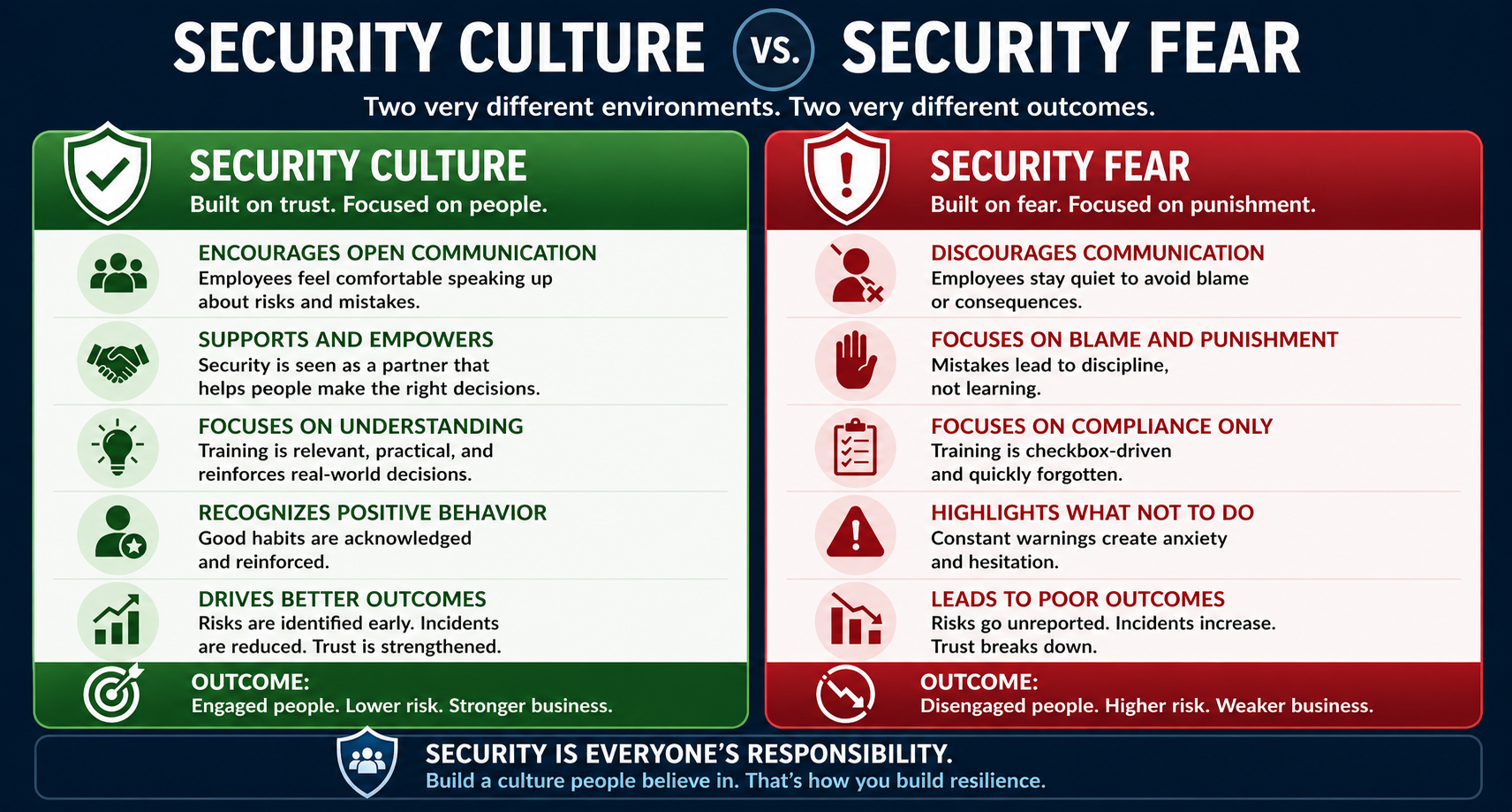
From my experience, organization unintentionally build their security programs around practices like strict enforcement, punitive responses, or even compliance pressure. These reflect a "don’t make a mistake” messaging. On paper, this seems logical.
However, In reality, it creates hesitation instead of action on the team member. Silence instead of actual reporting. An ultimately, avoidance instead of engagement. Employees begin to see security as something to either ignore or downright fear, not something to support.
The Problem With Fear-Based Security
From my experience, organization unintentionally build their security programs around practices like strict enforcement, punitive responses, or even compliance pressure. These reflect a "don’t make a mistake” messaging. On paper, this seems logical.
However, In reality, it creates hesitation instead of action on the team member. Silence instead of actual reporting. An ultimately, avoidance instead of engagement. Employees begin to see security as something to either ignore or downright fear, not something to support.
Why This Matters More Than Ever
Most modern attacks don’t begin with technology. Modern attacks begin with phishing emails, social engineering, credential misuse, and of course, human decision-making. This means that your first line of defense isn’t a tool, It’s your people! People tend to perform better in environments built on clarity in their policies, trust, and well thought out support -- not fear.
Real-World Perspective
In incidents involving organizations like Uber and Twitter, attackers leveraged human interaction and trust to gain access. These weren’t failures of awareness alone. They were failures in how organizations prepared their employees, how they supported their decision-making, and how they reinforced a secure behavior. The takeaway from this should be that Security is not just a control problem. It’s a behavior problem.
So What Does a Strong Security Culture Looks Like?
Again, from my experience and observation, I've noticed that organizations with effective security cultures generally share a few of the following characteristics:
Reporting Is Encouraged — Not Punished
Employees are rewarded for speaking up early. Even if they make a mistake. Because early visibility reduces impact.Security Is Positioned as a Partner
Instead of being seen as a blocker, security teams generally guide decisions, they enable safe outcomes, and they collaborate with the business.Training Focuses on Behavior — Not Just Completion
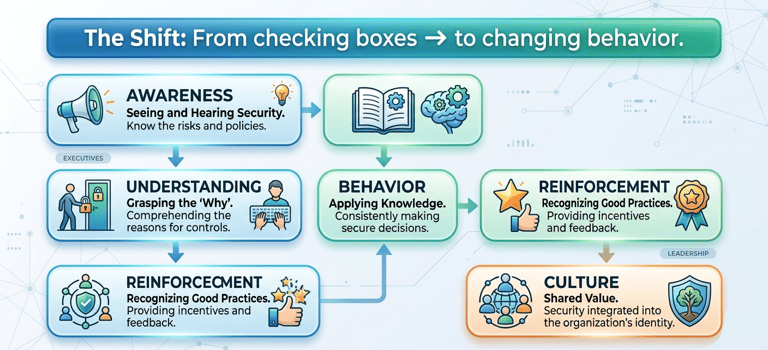
Annual training alone doesn’t change behavior. Effective programs will reinforce: real-world scenarios, decision-making under pressure, and practical response actionsLeaders Model the Right Behavior
Culture starts at the top. When leadership takes security seriously, follows policies, and engages with risk discussions, then the employees will follow.
The Role of Security Leadership
Security leaders play a critical role in shaping culture.
That means they should be removing fear from reporting process. They should be reinforcing positive behaviors. They should be aligning security with how people actually work. Ultimately, security leaders should be designing processes that support, not punish. Afterall, security culture is not defined by policies It’s defined by how people experience that security during each of their work days.
When Organizations Get This Right
When you have built a strong security culture, you'll begin to see that incidents are reported faster, your employees will start to act with confidence, your risk is identified earlier, and security becomes a part of daily decision-making processes. At that point, security is no longer a separate function. It has become part of how the organization operates.
You can invest in the best tools and controls available. But if employees are afraid to engage with security, those controls will always have gaps. Because the goal isn’t just to prevent mistakes. It’s to create an environment where people are comfortable doing the right thing.
Contact
Reach out for tailored security solutions.
© 2026. All rights reserved.